Why Don’t More Hours Grow Consulting Revenue? A Consulting Revenue Plateau Diagnosis
Flat near ₹8 lakh despite 60-hour weeks? Diagnose the consulting revenue plateau limiting capacity, pricing, delivery, or retention.

By Rohini Mundra, Founder · Updated 11 Oct 2026

In brief
We explain why more hours stop raising consulting revenue when sales, delivery, approvals, and client communication still depend on the founder. We show how to distinguish a slow period from a structural limit, diagnose the active constraint, choose a single structural change, and review the signals that prove whether it worked.
In this article
- 1Is This a Plateau or a Slow Period?
- 2Where Is the Extra Effort Going?
- 3Which Constraint Is Holding a Consulting Revenue Plateau Down?
- 4Read Capacity Before Acquisition
- 5Compare Margin and Delivery Hours
- 6Rule Out a Positioning Problem
- 7Why Can More Leads Make It Worse?
- 8What Structural Change Fits Each Constraint?
- 9Raise Prices When Capacity and Value Are Constrained
- 10Narrow Positioning When Custom Selling Is Draining Time
- 11Productise Delivery When Work Repeats
- 12Delegate When the Founder Is the Required Processor
- 13What Should You Measure Next?
- 14Work with Rohini Mundra
- 15FAQs on Consulting Revenue Plateau
Working 55 hours or more each week is already classed as long working hours in WHO and ILO research. A 60-hour week may show commitment, but it does not automatically create more saleable capacity.
A consulting revenue plateau happens when a founder-led practice has reached a structural capacity limit. If the founder still sells, delivers, approves, and manages every engagement, extra demand creates a longer queue, not more usable capacity. We diagnose the binding constraint in the business data, then change pricing, offer design, delivery ownership, or time allocation.
This article helps established solo consultants separate a temporary slow period from a genuine ceiling, identify the constraint, and test one structural change without confusing activity for growth.
Is This a Plateau or a Slow Period?
A quiet month is not necessarily a ceiling. Consulting revenue can move because a contract ended, a buyer delayed a decision, a referral source went quiet, or a seasonal pattern affected demand. We start by comparing comparable periods, rather than reacting to one difficult month.
A plateau becomes more likely when revenue remains in the same range while the founder’s calendar stays full, delivery waits lengthen, margins weaken, or new work cannot start without displacing existing work. The key question is not whether you feel busy. It is whether the same system keeps producing the same commercial result.
Seasonality matters because monthly numbers can carry recurring calendar effects. The NIST guidance on time-series analysis recommends checking recurring patterns before interpreting a trend. Compare like-for-like months, flag one-off projects, and separate signed revenue from cash collected.
If your delivery work is already booked and every important client decision needs you, the problem may be the same one explored in our capacity ceiling diagnostic. More effort can hide that constraint for a while, but it cannot remove it.
Where Is the Extra Effort Going?
A 60-hour week often contains four jobs compressed into one person: selling, delivering, approving, and communicating. Each can be valuable. The problem begins when none has a clear boundary, owner, or operating standard.
For the ₹8 lakh monthly scenario, 60 hours a week is roughly 260 hours in an average month. That works out to about ₹3,077 of revenue per founder hour before costs, sales time, administration, and non-billable work are separated. It is not a pricing recommendation. It is a prompt to find out where those hours actually go.
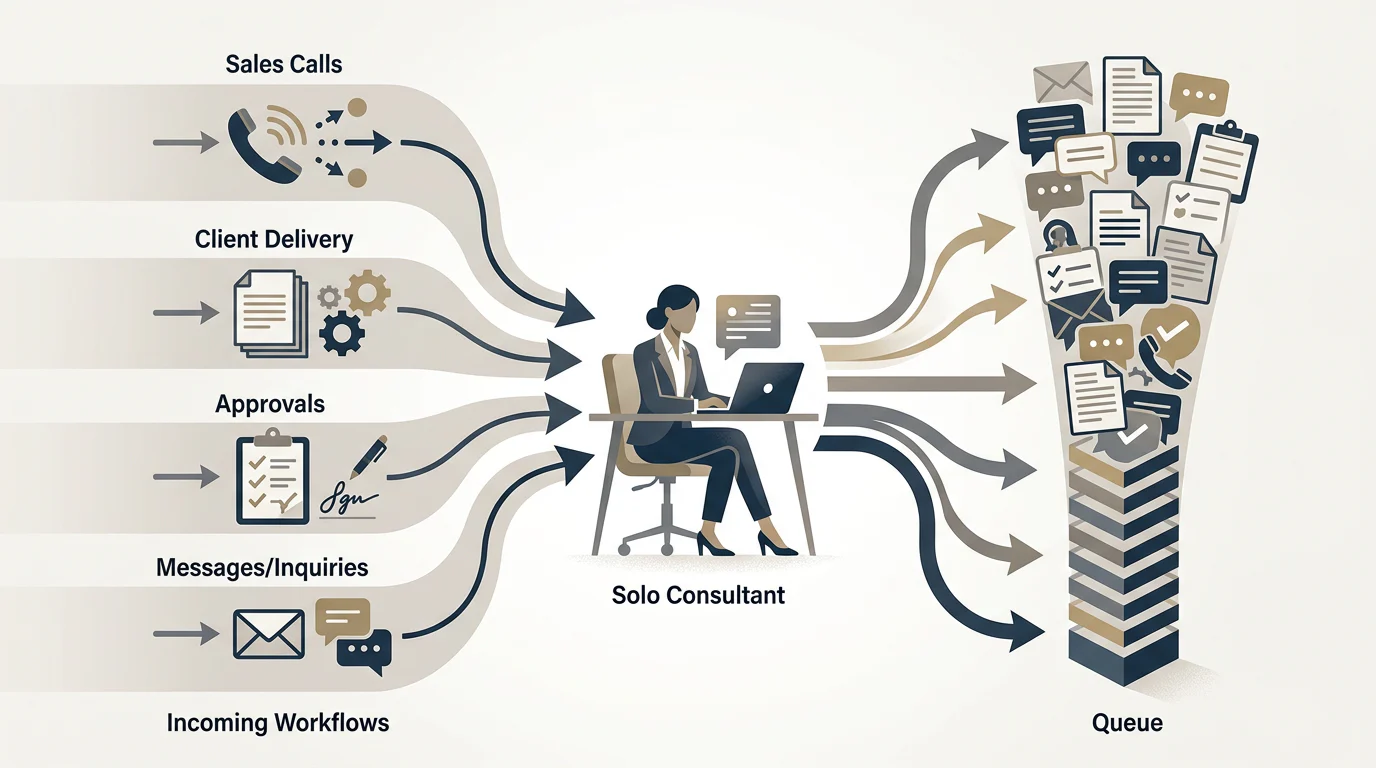
Service operations research explains why this matters. When demand arrives faster than one person can process it, waiting time and work-in-progress increase. In practical terms, high utilisation carries a high waiting-time cost, as explained in queueing research.
Track one representative week before changing anything. Record time spent on discovery calls, proposal work, delivery, revisions, approvals, client updates, and internal administration. A founder who spends most of the week delivering cannot solve a capacity problem by adding another campaign. Our founder capacity diagnostic can help make that workload visible.
Which Constraint Is Holding a Consulting Revenue Plateau Down?
The fastest route out of a ceiling is usually not a universal tactic. It is a clean diagnosis. We look for the metric that confirms the constraint and the evidence that rules out a tempting but incorrect explanation.
| Constraint | Symptom | Metric To Inspect | Confirming Evidence | False Diagnosis | Suitable Intervention |
|---|---|---|---|---|---|
| Capacity | Calendar is full and delivery waits grow | Founder delivery hours, weeks booked | Founder must attend or approve every milestone | “We need more leads” | Delegate defined work, productise, change scope, or reprice |
| Pricing | Revenue stays flat despite a full workload | Average project value, gross margin | Similar effort creates too little contribution per engagement | “Buyers will never pay more” | Repackage the value, scope, and commercial outcome |
| Positioning | Many conversations lead to vague, custom proposals | Qualified-call rate, proposal variance | Buyers cannot quickly identify the specific problem solved | “We need broader messaging” | Narrow the buyer, problem, and outcome |
| Acquisition | Unsold capacity and too few qualified opportunities | Qualified pipeline, source mix, close rate | Delivery capacity exists but demand does not | “Operations are the issue” | Improve channel fit, proof, referrals, and qualification |
| Delivery Efficiency | Rework and fulfilment hours keep rising | Planned versus actual hours, revisions | The same work is recreated for each client | “Clients are unusually demanding” | Standardise stages, templates, handoffs, and quality checks |
| Retention | Each month begins with a fresh chase for revenue | Repeat revenue, renewals, expansion | Good-fit clients do not continue or refer | “Acquisition alone fixes this” | Build a justified renewal, extension, or referral path |
Read Capacity Before Acquisition
If every new client creates more founder delivery, approvals, and messages, capacity is binding. The right question is whether a qualified new client can enter without slowing the service promised to current clients.
Compare Margin and Delivery Hours
Revenue alone can flatter a practice. Gross margin matters because a larger project that absorbs far more delivery time may not create a stronger business. The IRS definition calculates gross profit from receipts less applicable direct costs, then expresses gross margin as gross profit divided by sales revenue.
Rule Out a Positioning Problem
A calendar can be full of low-fit work. If proposal scope changes wildly, clients need excessive education, and projects begin without a clear commercial outcome, a positioning problem can look like a capacity problem.
Use the full constraint map to decide which data point deserves attention first. The aim is to name one primary constraint, not collect six improvement projects.
Why Can More Leads Make It Worse?
More leads help only when the business can qualify, respond to, onboard, and deliver for additional clients without damaging the current client experience. When delivery is already saturated, extra enquiries add messages, calls, proposals, and decisions to the same overloaded week.
That creates a familiar spiral. The founder delays response, lowers qualification standards to avoid losing opportunities, accepts work with unclear scope, and then spends more delivery time protecting the relationship. Revenue may briefly rise while margins, turnaround time, and energy fall.
A study of 2,241 small and mid-sized companies found that 37% responded to online leads within one hour, while 24% took more than 24 hours and 23% never responded. The accompanying HBS study found a faster response was associated with a much higher chance of reaching a decision-maker. That is a response-capacity lesson, not a reason to collect leads you cannot serve.
Before increasing demand generation, make three checks: someone owns qualification, response times do not depend entirely on the founder, and a new client has a real delivery slot. If revenue is stuck near the stated level, use our ₹8 lakh diagnostic before assuming the funnel is the only issue.
What Structural Change Fits Each Constraint?
The right structural change makes the limiting resource less limiting. It does not ask the founder to become more disciplined at sustaining an impossible operating model.
Consider a consultancy billing ₹8 lakh in a month while its founder works 60 hours each week. The useful audit is not, “How can we work harder next month?” It is, “Which part of this revenue still requires the founder, and which part can change without weakening the client outcome?”
| Operating Model Element | Before The Change | Test After The Change | Leading Signal |
|---|---|---|---|
| Sales | Founder handles every discovery call and proposal | Qualification criteria remove low-fit calls | Qualified-call rate |
| Pricing | Scope expands inside a fixed fee | Offer has defined scope and decision rights | Average project value and margin |
| Delivery | Every engagement is rebuilt from scratch | Repeatable stages use a standard process | Planned versus actual delivery hours |
| Approvals | Founder reviews every intermediate task | Defined quality checks trigger escalation only when needed | Founder approval hours |
| Retention | Work ends without a next-step conversation | Suitable clients receive a clear continuation path | Repeat revenue |
Raise Prices When Capacity and Value Are Constrained
Price is worth testing when the practice has good-fit demand, full capacity, clear results, and inadequate margin for the delivery required. We do not treat a price increase as a promise. We test it against scope, close rate, margin, and delivery hours.
Narrow Positioning When Custom Selling Is Draining Time
A narrower position does not mean a smaller ambition. It means a buyer can recognise the problem you solve, the outcome you help create, and the reason to choose you without a long explanatory call.
Productise Delivery When Work Repeats
Productising does not mean making the service impersonal. It means standardising the repeatable parts so founder judgement is reserved for the work that genuinely requires it. Process standardisation can reduce errors by reducing complexity and variation, according to this NIST case study.
Delegate When the Founder Is the Required Processor
Delegate preparation, coordination, administration, and defined delivery components only after documenting the expected quality, decision rights, and escalation path. A handoff without those conditions simply moves rework back to the founder.
A consultant who wants to preserve a lean team can explore our lean-scale model. The purpose is not hiring for its own sake. It is creating enough independent delivery capacity for the founder’s expertise to remain valuable.
What Should You Measure Next?
A useful weekly review is short enough to sustain and specific enough to expose the constraint. Start with a baseline from your own records, then run one change long enough to observe its effects. Avoid changing prices, positioning, acquisition, and delivery all at once.
Use this five-step audit:
- Reconcile monthly revenue and average project value to invoices.
- Tag founder hours as sales, delivery, approvals, client communication, or operating work.
- Measure gross margin and delivery hours by offer or client type.
- Trace qualified opportunities from acquisition source to close or loss.
- Select one primary constraint and one intervention to test for four weeks.
The weekly scorecard should match the constraint. For capacity, track founder delivery hours, backlog, and turnaround time. For pricing, track project value, margin, and quote acceptance. For positioning, track qualified-call rate and proposal variance. For retention, track renewal conversations, repeat revenue, and expansion margin.
Review the indicators for 20 minutes each week, then compare the completed month with the baseline. If the signals do not move, revise the hypothesis rather than adding another tactic. If you also run a coaching practice, our coaching revenue diagnostic applies the same discipline to a full calendar and flat revenue.
Work with Rohini Mundra
At Rohini Mundra, we work privately with established service founders who need a cleaner diagnosis before they buy another tactic. We start with the numbers that expose the constraint: revenue by offer, project value, gross margin, delivery hours, close rate, source quality, repeat revenue, and founder-only decisions. Then we choose one change worth testing, whether that is a clearer offer, a pricing conversation, a handoff, a delivery standard, or a retention path. Our role is not to add motivational pressure to an already full week. We help you replace assumptions with an operating model you can review weekly, so growth does not depend on you personally touching every sale, task, approval, and client message. Bring your current records, not a polished success story, and we will make the next decision visible with Rohini Mundra.
FAQs on Consulting Revenue Plateau
Why Does Working Harder Not Increase Consulting Revenue?
More hours increase revenue only while time remains available. When the founder must sell, deliver, approve, and communicate, added demand mainly lengthens the client queue for clients.
How Do I Know Whether My Revenue Plateau Is Structural?
Compare like-for-like months, account for seasonality and one-off projects, then inspect capacity, margin, backlog, pipeline quality, and repeat revenue. Stable constraints across measures require action.
When Can More Leads Help a Consulting Practice?
More leads help after you can qualify, respond to, onboard, and deliver for additional clients without slowing existing work. Otherwise, they increase workload and queue length.
Which Change Should a Solo Consultant Test First?
Test the change supported by your data, not the fashionable tactic. With a full calendar, begin by testing capacity, delivery design, pricing, delegation, and founder workload.