What Does the P.A.C.E. MSME Coaching Ecosystem Offer Founders?
P.A.C.E. MSME coaching ecosystem options explained: training, coaching, consulting, accountability, workplace fit, fees and questions to ask.

By Rohini Mundra, Founder · Updated 11 Oct 2026

In brief
We map the P.A.C.E. MSME coaching ecosystem for established service founders, separating its training, coaching, consulting, accountability, and workplace options. We show the published formats and fees, where implementation depth is unclear, how business stage changes fit, and what to confirm before committing.
In this article
- 1Who Does This Ecosystem Serve?
- 2What Does the Business P.A.C.E. Program Cover?
- 3Profitability
- 4Attracting Customers and Converting Sales
- 5Empowering Teams
- 6How Do the Five Published Offerings Differ?
- 7Training Versus Coaching
- 8Consulting Versus Accountability
- 9Digitalisation and Values-Led Guidance
- 10Which P.A.C.E. MSME Coaching Ecosystem Option Fits Each Stage?
- 11Early Validation Needs Restraint
- 12Established Operations Need a Diagnosis
- 13Owner Dependence Needs Implementation
- 14Leadership Needs More Than Culture Language
- 15What Evidence Supports the Published Claims?
- 16What Should Service Founders Verify Before Enrolling?
- 17Work with Rohini Mundra
- 18FAQs on P.A.C.E. MSME Coaching Ecosystem
India’s official dashboard recorded more than 9.6 crore registrations across Udyam and Udyam Assist records in September 2026. For an established service founder, that scale makes vague “MSME support” a poor basis for choosing help.
The P.A.C.E. MSME coaching ecosystem is best read as a menu of five support formats: a three-day diagnostic-style training, one-to-one coaching, on-site consulting, a longer accountability programme, and workplace development. The right choice depends on whether an established service founder needs diagnosis, implementation help, accountability, or stronger team habits, not on the boldest outcome claim.
We map the published options, separate provider claims from independently checkable facts, and show what to confirm before paying for support.
Who Does This Ecosystem Serve?
As reviewed on 18 September 2026, the public material positions this ecosystem around business training, coaching, consulting, and workplace development for MSMEs. It says the operating company has served this audience since 2008, with particular emphasis on founders trying to move from constant operational involvement toward more structured growth.
For service founders, “MSME” still covers a wide commercial reality. Since April 2025, the official limits classify a micro enterprise at up to ₹2.5 crore investment and ₹10 crore turnover, a small enterprise at ₹25 crore and ₹100 crore, and a medium enterprise at ₹125 crore and ₹500 crore under the current criteria. Those thresholds do not reveal whether your real constraint is positioning, lead flow, delivery quality, owner approvals, or second-line leadership.
That distinction matters because an established consultancy, agency, or specialist firm can have healthy revenue while still being founder-dependent. Before comparing programmes, we recommend diagnosing unclear priorities so the support format follows the operating problem.
What Does the Business P.A.C.E. Program Cover?
The Business P.A.C.E. Program is the ecosystem’s entry-level public training offer. Its published framework is Profitability, Attracting Customers, Converting Sales, and Empowering Teams. The current public listing describes a three-day, in-person programme at ₹21,999 including GST.
Profitability
The profitability component is presented as work on the business model, margins, delayed payments, financial goals, and sales improvement. That makes it useful as a broad commercial diagnostic, especially when a service founder cannot explain why revenue is not converting into dependable margin.
It is not, by itself, evidence that a specific service business will improve profit. We would treat the programme as a structured way to find and prioritise constraints, then compare the resulting plan with a revenue-constraint map.
Attracting Customers and Converting Sales
The framework separates attracting customers from converting sales, which is useful for a founder whose positioning problem is being confused with a closing problem. Public material also describes marketing, sales, and business-model training within longer support pathways.
For an established service business, the practical question is whether weak positioning means unclear offer design, weak proof, poor lead qualification, inconsistent follow-up, or a sales conversation that does not connect value to price. Those require different implementation work.
Empowering Teams
The team component covers hiring, people development, people-management systems, delegation, and building a business that relies less on the owner. That focus is relevant when delivery repeatedly returns to the founder for decisions or client escalation.
The published training can help establish a shared language for team ownership. It does not publicly commit to creating role scorecards, handoff standards, quality assurance routines, or management dashboards for a particular service business. When cost is the decision point, use our pricing decision guide before treating any programme fee as a return-on-investment decision.
How Do the Five Published Offerings Differ?
The clearest difference is not the marketing label. It is the depth of implementation: training teaches a framework, coaching provides guidance, consulting may work inside the business, the longer accountability option combines ongoing contact with intensives, and workplace development concentrates on people practices.
| Offering | Stated Problem Or Audience | Published Format | Publicly Stated Implementation Depth | Disclosed Price |
|---|---|---|---|---|
| Business Training / P.A.C.E. | Broad growth, profit, systems, team setup | Three-day in-person training | Action-plan and learning claims, no assigned coach commitment stated | ₹21,999 including GST |
| Business Coaching | Tailored growth guidance | Personalised one-to-one coaching | Guidance stated, but cadence and deliverables are not publicly detailed | Not publicly disclosed |
| Business Consulting | Specific business-model, audience, or operational need | Consultants visit the business | Custom solutions and implementation with the team are stated | Not publicly disclosed |
| Business-Acceleration Mastermind | Aggressive growth needing accountability | Monthly one-to-one contact plus intensives over six to 12 months | Messaging and email handholding, training, and resource access stated | ₹15,00,000 plus GST |
| Workplace Development | Communication, focus, collaboration, conflict, and trust | Self-paced leadership and culture training | Team-learning curriculum stated, live rollout details need confirmation | ₹99,999 plus GST |
Training Versus Coaching
Training is the sensible starting point when the founder needs a common framework or first diagnosis. Coaching is potentially stronger when decisions need to be tested against the business regularly, but only if the coach, rhythm, access method, and expected outputs are written down.
For a broader format decision, compare this table with our support-format guide.
Consulting Versus Accountability
Consulting is the closest public match for a founder who needs people to understand the business, create a customised solution, and work with the team. The mastermind is the closer match when the work is already defined but the founder needs longer accountability and correction.
Neither label proves that a consultant will own your CRM build, sales-process rollout, delivery redesign, or team adoption. Those responsibilities should be contractual, not inferred from the word “implementation.”
Digitalisation and Values-Led Guidance
The published offers focus on commercial systems, sales, leadership, and team performance. They do not set out a defined software-selection, ERP, CRM, migration, cybersecurity, or integration service. That is a meaningful scope gap because a government RAMP survey of 5,016 MSMEs found only about 4% had adopted the specified digital-transformation tools.
The provider publishes organisational values, but the reviewed offer descriptions do not publish a values-led governance curriculum, ethical decision framework, or measurement method. Founders seeking either digitisation or values-led guidance should ask for a separate written scope.

Which P.A.C.E. MSME Coaching Ecosystem Option Fits Each Stage?
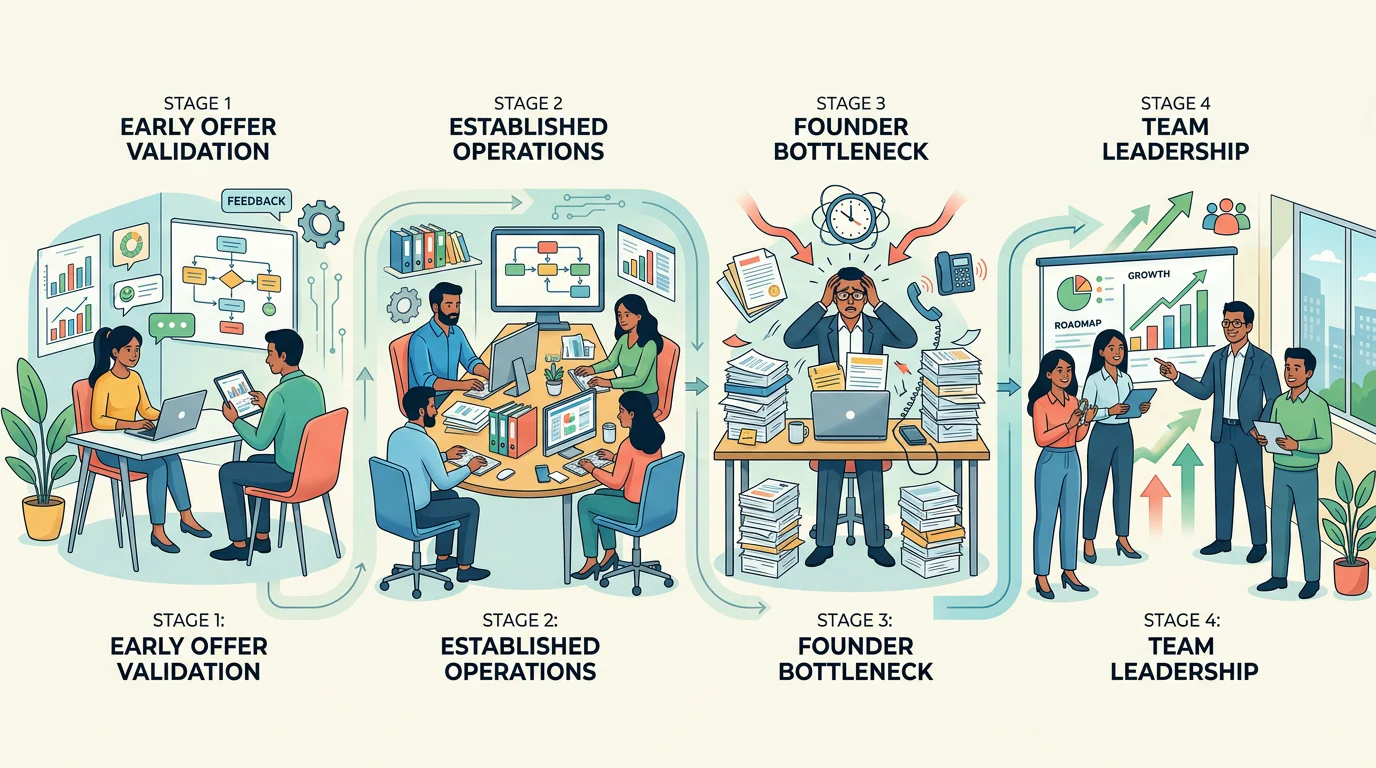
The P.A.C.E. MSME coaching ecosystem makes more sense when chosen by business stage. A founder should not buy a longer or more expensive offer simply because the business feels difficult. The key is whether the immediate need is validation, diagnosis, implementation, or leadership capacity.
| Business Stage | Typical Service-Business Condition | Provisional Fit | What To Confirm First |
|---|---|---|---|
| Early Validation | The offer, buyer, or repeatable sales process is unclear | Training or a narrow diagnosis | Whether the work will test demand rather than add systems too early |
| Established Operations | Clients and staff exist, but profit, pipeline, or workflow gaps are unclear | P.A.C.E. training or scoped consulting | The precise bottleneck and the output expected after diagnosis |
| Owner Dependence | The founder approves sales, delivery, and operating decisions | Consulting or longer accountability | Who creates systems, trains the team, and checks adoption |
| Second-Line Leadership Need | Delivery exists, but ownership and management consistency are weak | Workplace development or implementation support | Whether role design, QA, incentives, and manager rhythm are included |
Early Validation Needs Restraint
A new service offer usually needs customer evidence before it needs a large operating system. Training can help the founder think through commercial basics, but it should not replace live conversations, offer testing, and proof of demand.
Established Operations Need a Diagnosis
An established firm can benefit from the three-day programme when the owner needs to see the whole operating picture. It is a less reliable fit if the bottleneck is already obvious and requires specific work, such as fixing delivery handoffs or rebuilding client onboarding.
Owner Dependence Needs Implementation
When every important decision returns to the owner, advice without implementation often becomes another item on the founder’s list. We would compare consulting scope with mastermind or private support before assuming accountability will create operational ownership.
Leadership Needs More Than Culture Language
Workplace development can strengthen communication, conflict handling, focus, collaboration, and trust. A dependable delivery team also needs explicit roles, client standards, escalation rules, capacity planning, and feedback loops.
What Evidence Supports the Published Claims?
We separate what the provider says from what a founder can independently verify. This protects against the common mistake of treating a testimonial, audience count, or sales-page promise as evidence that a programme will solve a specific delivery or growth problem.
The strongest independently verifiable material in this decision is not usually a programme outcome claim. It is the offer’s documented format, written terms, price, named support, and the relevant business baseline. For a founder considering digital work, we would begin with a digital transformation guide, then assess whether external support fills the resulting gaps.
| Evidence Type | What We Can Reliably Say | How To Use It |
|---|---|---|
| Provider Claims | Public pages describe formats, curriculum topics, prices, and stated support | Attribute them to the provider and date the page review |
| Independently Verifiable Facts | Government MSME definitions and digital-support programmes are public | Use them for business context, not programme outcomes |
| Testimonials | Participant stories may show perceived value | Treat them as individual experiences, not controlled evidence |
| Information Not Publicly Disclosed | Coach-assignment method, credentials, acceptance criteria, milestone deliverables, and outcome-measurement methods are not detailed in reviewed pages | Request written answers before enrolling |
The provider’s reach, industry, revenue, and transformation figures should remain provider-reported unless independent evidence is available. This is not a minor wording issue. It changes whether a founder is buying a learning experience, an advisory relationship, or a managed implementation project.
What Should Service Founders Verify Before Enrolling?
A good enrolment conversation should become more specific as the price and commitment increase. Ask for answers in writing, then compare them with the operational problem you are trying to solve.
- Assigned-Coach Access: Ask whether a named coach is assigned, how often you meet, how questions are handled, and what response time applies.
- Implementation Ownership: Confirm whether we, the founder, the internal team, or the provider owns each action after the initial recommendation.
- Deliverables: Request a list of tangible outputs, such as positioning work, sales stages, SOPs, role scorecards, dashboards, or delivery-quality checks.
- Technology Scope: Ask whether software selection, setup, migration, integration, training, and post-launch support are included or excluded.
- Fees And Terms: Confirm GST, team-seat costs, travel, follow-on fees, cancellation, refunds, transfers, and rescheduling before payment.
- Success Measures: Set a starting baseline and review date for the constraint being addressed, not a generic promise of scale.
If your main constraint is commercial rather than organisational, our consulting-revenue diagnostic can help separate a positioning problem from a capacity, pricing, pipeline, or delivery issue.
Work with Rohini Mundra
At Rohini Mundra, we help established service founders turn a vague growth problem into a written decision about positioning, pipeline, delivery capacity, and team ownership. We do not ask you to choose a format because it sounds intensive. We start by identifying the bottleneck, the people who must implement the work, and the proof that would show movement. That makes it easier to decide whether you need positioning work, a practical operating system, a technology project, leadership development, or simply a narrower next step. Our written scope sets out intended outcomes, boundaries, working rhythm, responsibilities, and what we need from you before work begins. If dependable delivery matters, we examine roles, handoffs, client standards, and founder approvals together, rather than treating culture as a substitute for operating design. See the scope, assess it for your business, and decide whether it fits at Rohini Mundra
FAQs on P.A.C.E. MSME Coaching Ecosystem
These FAQs separate published formats from implementation work. We recommend matching the option to the business constraint, then confirming scope, support, price, and responsibilities in writing.
Does This Ecosystem Offer Coaching or Consulting?
Yes. Public pages describe coaching and consulting separately, but founders should confirm the assigned coach, meeting cadence, deliverables, access method, and implementation responsibilities in writing.
Which Option Suits an Established Service Business?
Choose by the immediate constraint: P.A.C.E. for broad diagnosis, consulting for a defined implementation change, or longer accountability after comparing the specific support and deliverables offered.
Can the Listed Offers Digitise a Small Business?
No. Public descriptions do not promise software implementation. Confirm who selects tools, configures workflows, migrates data, trains staff, measures adoption, and owns ongoing technical support.
Who Needs Help Building a Dependable Delivery Team?
Founders with delivery failures need a written scope covering role ownership, client handoffs, quality checks, management rhythm, measurable improvements, and the person responsible for adoption.