Six Records That Test an Online Coaching Claim Before You Pay
Use six written records to check provider identity, curriculum, live delivery, total cost, terms and payment proof before joining online coaching.

By Rohini Mundra, Founder · Updated 29 Sept 2026

In brief
A complaint or testimonial is a prompt to inspect a purchase, not proof that a programme will or will not work. Before paying, collect six records: provider, offer, delivery, total cost, terms and payment proof.
In this article
Complaint snippets tell you where to look
ConsumerComplaints.in currently shows 8 Rohini Mundra complaint posts dated from 2018 to 2023. The platform describes itself as a place for consumers to share concerns, so the posts are evidence of what individual users wrote, not independent findings about any particular programme. ConsumerComplaints.in’s Rohini Mundra profile is most useful for turning broad allegations into precise questions before you buy.
Use this checklist for the offer in front of you in September 2026. A dated review cannot establish today’s curriculum, delivery format, fee, terms or support boundary.
Start with the party taking payment
Match the seller’s legal identity to the payment page, invoice or receipt and cancellation contact. For a GST-registered supplier, CBIC’s 2017 invoice rules require identifying information including the supplier’s name, address and GSTIN, as well as invoice details and tax information.
The practical test is simple: the provider name on the offer, payment confirmation and terms should describe the same purchase. If one document uses a trading name and another uses a company name, ask for the relationship in writing before you pay.
Turn every promise into a row
Our current Xtraordinary Speakers Academy workshop is a live, three-day workshop running 2–4 October 2026 and costing ₹199. It is for aspiring coaches, experienced professionals, entrepreneurs and teachers who want to structure expertise into a coaching business.
We cover launching a coaching business and finding a niche on day one, AI for content, marketing and customer support on day two, and automation and scale on day three. We include live demonstrations and a dedicated Q&A. Technical support is available through webinar-platform chat, and the workshop is not recorded afterwards. For the wider programme context, see Xtraordinary Speakers Academy cost, curriculum and fit.
| Record | What to capture | Question it answers |
|---|---|---|
| Provider | Legal name, contact route and payment recipient | Who is contracting with me? |
| Offer | Programme name, version, date and access period | What am I actually buying? |
| Delivery | Live or recorded format, curriculum, session times and Q&A | What will happen, and when? |
| Total | Fee, taxes, instalments and separate costs | What is the full commitment? |
| Terms | Cancellation route, refund calculation, changes and rescheduling | What happens if plans change? |
| Record | Written support boundary, invoice or receipt, and payment confirmation | What evidence will I have later? |
A provider can offer useful teaching without offering every kind of support. Training, mentoring, coaching and implementation are different purchases. If you need a finished business asset or specialist work, obtain named deliverables, an owner and acceptance criteria rather than assuming a guidance format includes them.
Make the total and exit terms calculable
For our workshop, the FAQ states that the attendance cost is non-refundable. Our general terms also set out written-cancellation language, possible deductions, timing and treatment of separately incurred travel, meals and accommodation. Read the terms that apply to your exact purchase, then keep that version with the payment record. Our cancellation and refund terms explain the details to request before enrolment.
For covered inventory e-commerce entities, India’s 2020 Consumer Protection (E-Commerce) Rules require clear information on return, refund, payment and grievance-redressal matters. The Department of Consumer Affairs rules are a useful reason to ask for the commercial details before checkout, although the rules’ application to a particular transaction is a legal question.
Do not compare a headline fee alone. Compare the programme version, tax treatment, inclusions, access period, payment schedule, cancellation treatment and costs that sit outside the fee.
Keep a trail that answers a later question
Save the offer or quote before payment, then save the terms, receipt or invoice, joining instructions and written support messages in one folder. A complete record lets you compare the commitment you accepted with the delivery you receive.
The International Coaching Federation’s 2025 Code of Ethics describes a coaching agreement as covering goals, session duration and frequency, confidentiality, payment, cancellation and responsibilities. ICF’s 2025 code applies to its professional ecosystem, but its agreement categories make a useful practical checklist for any coaching conversation.
A six-record buying trail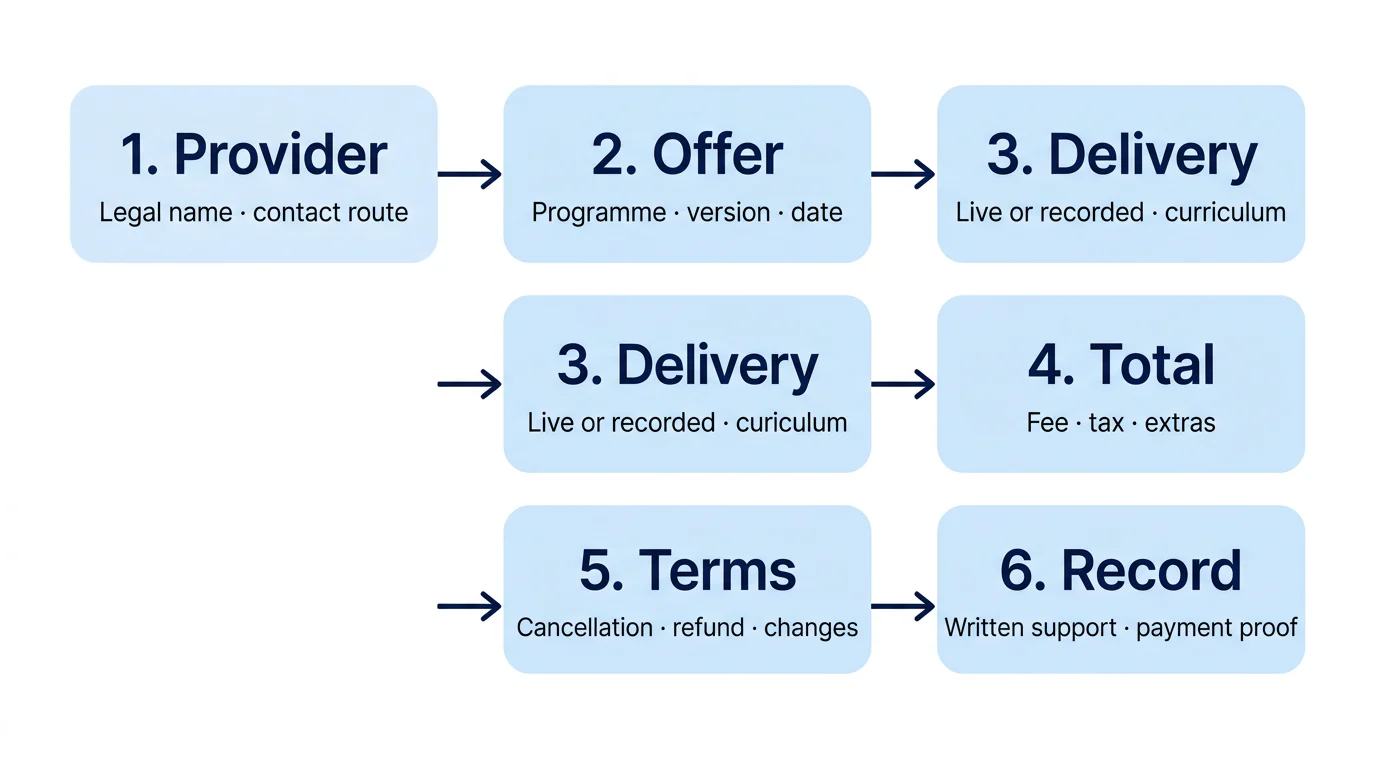
Use independent reviews last, not first. Check whether a reviewer identifies the same programme version, delivery period and terms you have in writing. That keeps an old experience from being mistaken for proof about a different purchase.
A strong buying decision is based on a visible match between the work you need and the commitment the provider has agreed to deliver.