
Glossary
Warrior Mindset
A warrior mindset is the ability to act steadily under pressure using trained mental skills such as breathing, self-talk and review.
By Rohini Mundra, Founder · Updated 24 Oct 2026
On this page
- 01Definition
- 02Quick facts
- 03What is a warrior mindset, and where does the term come from?
- 04Which skills do the military teach under the name warrior mindset?
- 05Does a warrior mindset improve performance, or is it only motivation?
- 06How do warrior habits differ from hustle culture?
- 07How can a founder practise a warrior mindset in seven days?
- 08What is a warrior mindset often confused with?
- 09How Rohini Mundra handles it
- 10Example
- 11Related terms
- 12Frequently asked
What is a warrior mindset?
A warrior mindset is the ability to stay steady and keep acting under pressure, built from specific mental skills that can be practised. Military and law-enforcement training use the phrase.
Key takeaways
- The US Army video shows six skills and the US Navy teaches a similar set, including a 5-second-in, 7-second-out breathing drill. Several overlap, such as self-talk and breathing.
- Research links mental toughness to better performance and lower stress, but mostly through self-reported, correlational studies. Test every habit on yourself.
- The line between warrior habits and hustle is recovery and asking for help. The seven-day card tests that on yourself.
Quick facts
- Used by
- US Army, US Navy and law-enforcement training
- Army programme
- Performance and Resilience Enhancement (PRE) training, under Army Regulation 350-53
- Navy name
- Warrior Toughness
- Navy breathing count
- In for 5 seconds, out for 7
- Closest researched idea
- Mental toughness
Search for warrior mindset and one name covers two ideas. One is a hustle slogan: rise early, feel no fear, never stop. The other is a short list of skills that soldiers and recruits are taught on purpose, such as slowing the breath and reviewing what happened.
Only the second has a training method behind it. The US Army's Walter Reed Army Institute of Research (WRAIR) shows six mental skills in a training video about a patrol. The US Navy teaches recruits a similar set of skills, including a breathing drill and mental rehearsal. Neither list includes fearlessness or going without sleep.
That matters if you run a business or lead a team. You do not need a combat attitude. You need a few habits that hold when a client leaves, a launch slips or a bad night makes everything look worse.
Below you will find the meaning, the skills in founder terms, a test for telling warrior habits from hustle, and a seven-day card to try for yourself.
What is a warrior mindset, and where does the term come from?
The phrase is used in military and law-enforcement training. The book Warrior Mindset: Mental Toughness Skills for a Nation's Peacekeepers (Asken, Christensen and Grossman) was written for police officers.
Military training still uses the term. The Center for the Study of Traumatic Stress (CSTS) runs a Warrior Mindset project. It updates videos for the Army's mandatory Performance and Resilience Enhancement (PRE) training under Army Regulation 350-53. The videos teach coping and problem-solving, connectedness and protective environmental factors, in realistic scenarios. These are coping skills, not combat tactics.
Which skills do the military teach under the name warrior mindset?
The US Army video shows six skills and the US Navy teaches a similar set, including a 5-second-in, 7-second-out breathing drill. Several overlap, such as self-talk and breathing.
These skills were designed for soldiers and recruits.
- Programme
- US Army, WRAIR Warrior Mindset video
- Skills named
- Self-talk, buddy-talk (talking with a teammate), deliberate breathing, psychological grounding (bringing attention back to what is physically around you), controlling the controllables, personal after-action review (looking back at what happened and what to change)
- Programme
- US Navy, Warrior Toughness (introduced late 2018; DVIDS article dated 16 November 2021; Navy Warrior Toughness components page)
- Skills named
- Recalibration (breathe in for 5 seconds, out for 7), mindfulness, goal setting, self-talk, mental rehearsal (visualisation) and energy management
Does a warrior mindset improve performance, or is it only motivation?
The closest researched idea is mental toughness, a personal trait, measured by questionnaires, that describes coping with pressure and setbacks. It is linked to better performance and lower stress, but the studies show association, not proof that training causes it. A 2017 systematic review in Frontiers in Psychology covered 51 papers describing 56 studies. It associates mental toughness with better academic and work performance, lower perceived stress, fewer depressive symptoms and better sleep.
The same review lists limits: heavy use of self-report, few long-term studies and few intervention studies. It also notes that about half the variation in mental toughness is attributed to genetics. So treat each habit as an experiment on yourself, not a promise.
How do warrior habits differ from hustle culture?
Warrior habits include stopping to recover and asking for help, which hustle culture leaves out.
Warrior habits versus hustle culture, side by side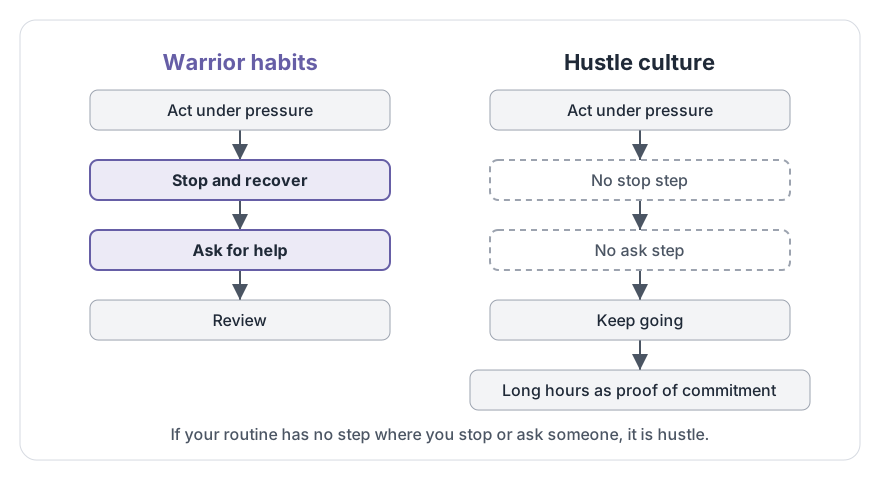
A simple test: if your routine has no step where you stop or ask someone, it is hustle, however disciplined it feels.
- Moment
- Bad news arrives
- Warrior habit
- Slow your breath, then act on what is yours to act on
- Hustle habit
- React instantly and try to fix everything tonight
- Moment
- You are stuck
- Warrior habit
- Talk to one peer
- Hustle habit
- Hide it and push alone
- Moment
- Fear shows up
- Warrior habit
- Notice it and take the next step
- Hustle habit
- Pretend it is not there
- Moment
- The day ends
- Warrior habit
- Review what happened, then stop
- Hustle habit
- Keep working and skip the review
How can a founder practise a warrior mindset in seven days?
Pick one pressure moment a day and score your steadiness from 1 to 5 straight afterwards. This is the Pressure Skills Card. It adapts the Army and Navy skills and has not itself been tested.
Pass or fail. On days 1, 3, 5 and 7, use two or more skills in your pressure moment. On days 2, 4 and 6, use none. Score each moment 1 to 5 straight afterwards. Compare the two averages. A gap of 1 point or more counts as a pass. If there is no gap, change the skill, not the standard. For a longer daily practice, see the guide to meditation for entrepreneurs.
- Skill
- Self-talk
- One-minute founder version
- Before a hard call, say one sentence: "I will ask for the decision."
- Skill
- Buddy-talk
- One-minute founder version
- Message one peer: what happened, what I will do next.
- Skill
- Deliberate breathing
- One-minute founder version
- Breathe in for 5 seconds and out for 7, for five rounds. The 5 and 7 come from the Navy count; five rounds is a suggested number.
- Skill
- Grounding
- One-minute founder version
- Name five things you can see and two you can hear. The five-and-two count is a suggestion; the Army video does not specify a count.
- Skill
- Controlling the controllables
- One-minute founder version
- Write what is yours today. Circle one item.
- Skill
- After-action review
- One-minute founder version
- Three lines: what happened, what I did, what I would change.
What is a warrior mindset often confused with?
A warrior mindset is most often confused with resilience, mental toughness and hustle. They are related but different.
- Resilience: the American Psychological Association defines it as "the process and outcome of successfully adapting to difficult or challenging life experiences, especially through mental, emotional, and behavioral flexibility". It is the result a warrior mindset aims for.
- Mental toughness: the researched trait, measured by questionnaires, behind the military term.
- Hustle culture: long hours as proof of commitment. It is not a skill set.
- Entrepreneur mindset: a wider question of how you think about building a business. See Entrepreneur Mindset.
- Limiting beliefs: the stories that stop you acting. See Limiting Beliefs.
How Rohini Mundra handles it
Our Private Coaching is a three-month programme. Month 1, Inner Awareness, helps you understand your nature and quiet overthinking. Month 3, Living the Wisdom, is about applying peace in real life, under real pressure. The Heart of Business is our group programme, with interactive sessions that support career shifts, relationship changes and inner blocks. It runs as single sessions or flexible packages.
We do not teach military skills. If you want to know whether a mindset coach or a life coach suits you, read Mindset Coach vs Life Coach. To ask about fees or fit, contact us, call +91 7760095707 or email rohinimundra@rohinimundra.com.
Example
Your biggest client cancels on a Friday afternoon. You breathe for five rounds, list three things you control (reply, cash check, one call), message a peer, then write a three-line review and close the laptop. You score the moment a 3.
Frequently asked
Sources
- 1.Warrior Mindset: Gaining a Tactical Advantage, Center for the Study of Traumatic Stress
- 2.Warrior Mindset video focuses on mental skills development, Walter Reed Army Institute of Research
- 3.Warrior Toughness: Skills for Every Warfighter, DVIDS, 2021-11-16
- 4.Warrior Toughness components, Naval Education and Training Command
- 5.Mental Toughness and Individual Differences: A Systematic Review, Frontiers in Psychology (Lin, Mutz, Clough and Papageorgiou), 2017
- 6.Resilience, American Psychological Association
- 7.Warrior Mindset: Mental Toughness Skills for a Nation's Peacekeepers (Google Books record), Asken, Christensen and Grossman