How to Stop Overthinking: A 15-Minute Card and a 7-Day Test
To stop overthinking, sort each thought into one you can act on or one you park, give worries a fixed 15-minute slot daily, and track the result for seven days.

By Rohini Mundra, Founder · Updated 23 Oct 2026

Key takeaways
- Ask of every looping thought: "Can I do something about this in the next 24 hours?" If yes, write the smallest next step and a time. If no, park it on a list and deal with the list in one fixed 15-minute slot.
- Test the method for seven days with a one-line daily log. Trials of worry postponement found a small reduction in time spent worrying, so expect a modest change.
- At night, write the thought and one action for tomorrow, then stop. We recommend holding your worry time in the early evening, at least an hour before sleep.
- If the loop is daily, disturbs your sleep or relationships, or makes you avoid things, call Tele-MANAS on 14416 or see a clinician. Do not stretch self-help to cover it.
In this article
- 1How do you stop overthinking? Use the Worry or Act card
- 2Why does fighting a thought keep the loop going?
- 3How much relief should you expect from worry time?
- 4How do you know in seven days whether the method is working?
- 5What helps with overthinking at bedtime?
- 6What if you overthink business or career decisions?
- 7When is overthinking a job for a professional?
- 8How can coaching help you quiet overthinking?
- 9Frequently asked questions
In our experience, trying to ban a thought tends to keep it in view. A thought needs a destination, not a ban. Overthinking behaves like a habit, and a habit changes when you replace the loop, not when you fight it.
Researchers call the habit repetitive negative thinking: worry about what might happen and rumination about what already did. A 2025 meta-analysis, which pools many trials into one result, covered 55 randomised trials. It found that cognitive behavioural therapy (CBT) reduced repetitive negative thinking by a moderate amount (Psychological Medicine, 2025).
You do not need to wait for therapy to start. The card below takes minutes to set up, and a seven-day log shows you whether it is working, in your own numbers. We also mark the point where self-help runs out, because that line matters more than any technique.
How do you stop overthinking? Use the Worry or Act card
Ask one question of every looping thought: can I do something about this in the next 24 hours? If yes, write the smallest next step and the time you will do it. If no, park the thought on a list and deal with the list in a fixed 15-minute slot called worry time.
The Worry or Act card
- Write the thought in one line.Pass: it fits in one sentence. If it does not, you are holding several thoughts, so write one line for each.
- Ask: can I do something about this in the next 24 hours?Pass for "yes": you can name a first step that starts with a verb, takes under 15 minutes and has a time. If you cannot name one within a minute, the answer is no.
- If yes, schedule the step.Put it in your calendar or phone, not your head: send the message, book the appointment, open the document. Pass: it has a time attached.
- If no, park it.Add one line to your parking list (a paper note or a phone note) and tell yourself "it's on the list." Pass: it is written down.
- Hold worry time.Fifteen minutes, same place, same time every day, timer on. Take each item on the parking list and write one action for it, or write "can't control" and cross it out. When the timer rings, stop. Unfinished items wait until tomorrow. Pass: the timer rang, you stopped, and every item you reached has an action or is crossed out as "can't control". Fail: you ran over 15 minutes.
When a thought returns outside worry time, you already have a place for it, so the answer is "it's on the list". A slot of 10 to 15 minutes is the length the NHS self-help guide on tackling worries recommends, and we cap ours at 15. Our recommendation on timing is the early evening, at least an hour before sleep, so the worrying does not land at bedtime. That is our choice, not a figure from a trial.
Thoughts about the past go straight to step 4, with one exception. If a repair is possible, such as an apology or a clarifying message, schedule it. Otherwise write one line on what you would do differently next time and park the rest.
Why does fighting a thought keep the loop going?
Fighting a thought, checking it and researching it all treat the thought as a threat that must be settled. Each gives short relief and tells your mind the thought was important. Four habits keep the loop alive, and each has a fix.
- Fighting the thought. In our experience, a thought you push away comes back. The fix is to park it, not argue with it.
- Checking for reassurance. This means rereading a message, asking three friends whether someone is upset, or searching for the perfect answer. Test: if you have checked the same thing twice, the third check is the loop. Allow one check, then park the rest.
- Mixing up fact and interpretation. "They haven't replied" is a fact. "They must be angry with me" is an interpretation. Before parking the thought, write two columns, "what I know" and "what I'm assuming", and put every phrase in one.
- Letting worry time grow. A 15-minute slot that becomes an hour is another all-day session. The timer is part of the method.
Spotting which of these you do is a self-awareness job. Our 7-day self-awareness test shows you your own pattern.
How much relief should you expect from worry time?
Expect a modest amount. A meta-analysis of seven randomised trials, where people are assigned to a method by chance, with 999 participants found that postponing worries to a set time reduced how long and how often people worried, but only by small effects: d = 0.313 for duration and d = 0.189 for frequency (International Journal of Cognitive Therapy).
An effect size (d) measures how far apart two groups end up, in standard-deviation units. Around 0.2 is conventionally called small and 0.5 moderate. The comparison group in those trials only recorded their worries, so the gain is on top of simply noticing them. People practised for between one week and one month, and long-term follow-up is lacking.
Treatment built around the habit does more. In the 2025 meta-analysis of CBT for repetitive negative thinking (55 randomised trials, 4,970 participants), the overall effect was moderate (g = 0.67, a similar effect-size measure). Treatments aimed specifically at repetitive negative thinking did better (g = 0.99) than general approaches (g = 0.56), and the gains held at short-term follow-up (Psychological Medicine, 2025).
Our inference: these figures come from different studies and different groups, so they cannot be compared head to head. They do point the same way. Worry time is a sound first step. If it does not shift the loop, a treatment aimed at the loop is the next one.
How do you know in seven days whether the method is working?
Fill in one line a day for seven days, then compare the average of days 1 and 2 with the average of days 6 and 7. A lower number for minutes overthought, or for minutes to fall asleep, means the method is working for you. No change after two weeks means it is time to move to a professional.
| Day | Minutes I overthought (estimate at end of day) | Items on the parking list | Items I scheduled an action for | Minutes to fall asleep (rough) |
|---|---|---|---|---|
| 1 | ||||
| 2 | ||||
| 3 | ||||
| 4 | ||||
| 5 | ||||
| 6 | ||||
| 7 |
Your estimates will be rough. That is fine as long as you estimate the same way each day, so you compare like with like.
Example of the arithmetic (made-up numbers, not data): days 1 and 2 are 90 and 80 minutes, an average of 85. Days 6 and 7 are 60 and 70, an average of 65. The drop is 20 minutes, which is 20 ÷ 85, about 24%.
Our rule of thumb for reading your result:
- A drop of about a fifth or more is a clear pass.
- A smaller drop earns a second week.
- No drop after two weeks of honest use is a fail, and the next step is a professional.
- If worry time itself leaves you more anxious, stop and speak to a professional.
What helps with overthinking at bedtime?
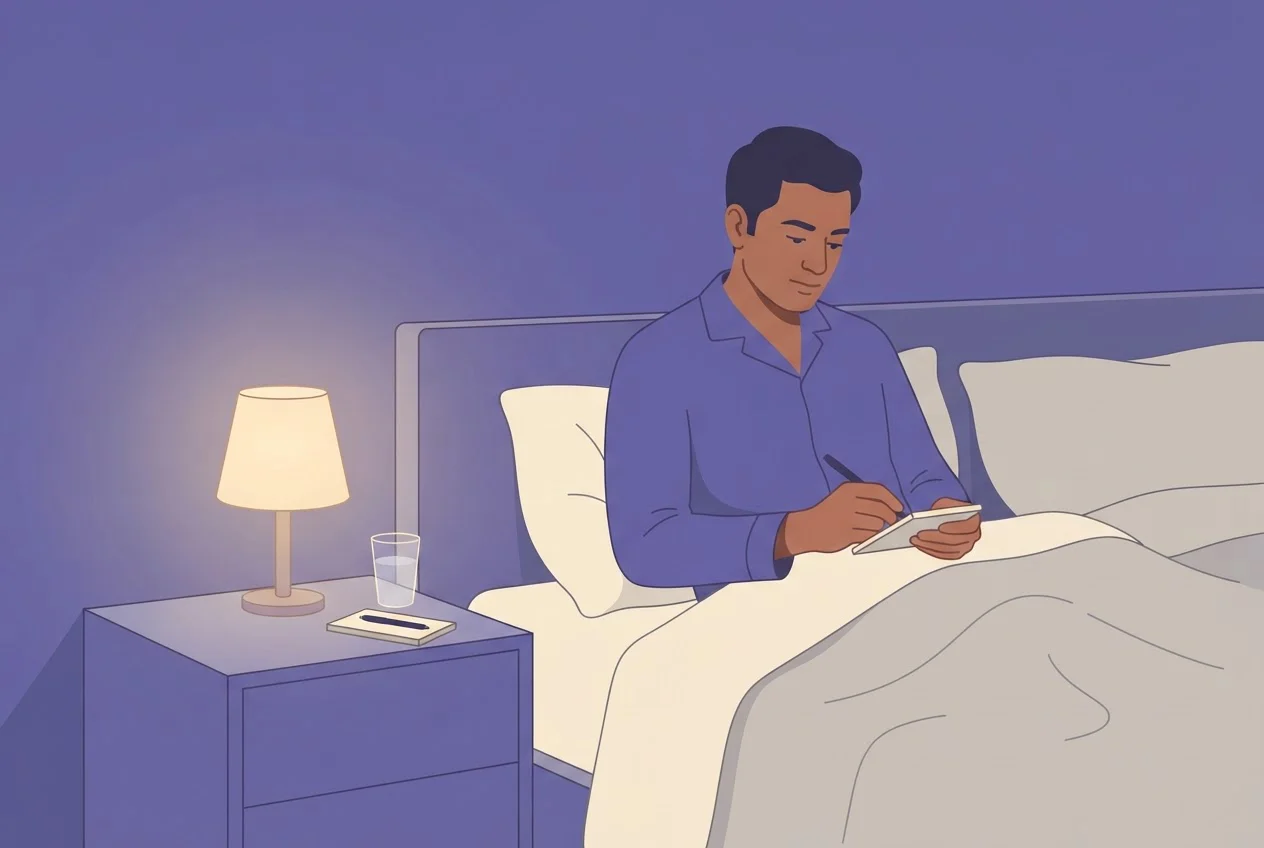
Keep a notepad by the bed. When a thought starts looping, write the thought and one action for tomorrow, then stop. Writing worries down is a standard self-help step for clearing the mind (NHS). The action line gives the thought a destination, so you are no longer holding it in your head.
Many people find the loop is loudest at night, when nothing else competes for attention. That is why we recommend worry time in the early evening. By bedtime the list has already been dealt with, so a thought that arrives in bed has an answer: "it's on the list, and tomorrow's action is written."
What if you overthink business or career decisions?
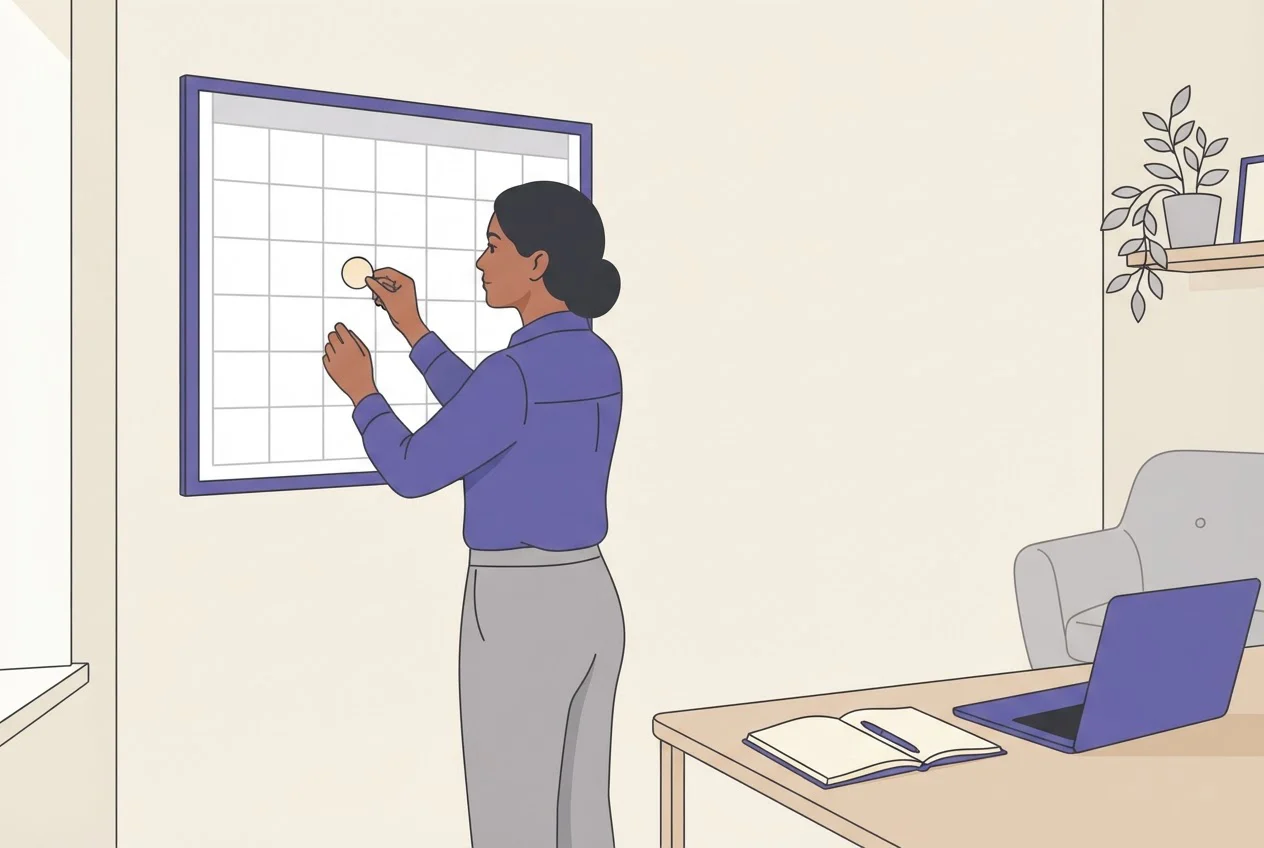
Put a decide-by time on the decision and sort it by whether you can undo it. For a reversible decision, decide once you have the facts you can get before the decide-by time, because a correctable mistake costs less than waiting. For an irreversible decision, write down the facts you can actually obtain before the deadline, and get those.
Then ask: what would change my mind? If nothing new can arrive before the date, you already have what you need, so decide now. Extra research on a decision that no new fact can change is the checking loop in a professional outfit.
If the loop sounds like "what will people think of me?", that is a belief you can test. Our 7-day limiting beliefs test shows how.
When is overthinking a job for a professional?
Overthinking needs a professional when it is daily, disturbs your sleep or relationships, makes you avoid situations, or two weeks of the card change nothing. Overthinking is not a diagnosis. Worry plays a central part in several conditions, including anxiety disorders and depression (International Journal of Cognitive Therapy).
In India, Tele-MANAS (Tele Mental Health Assistance and Networking Across States), the national mental health helpline, is free and open 24 hours on 14416, in English and 20 regional languages. Trained counsellors give basic counselling and can connect you to a mental health professional, with a video consultation if you consent. If you are thinking of harming yourself, call 14416 now, or call 112 in an emergency.
Not sure whether you need a coach, a therapist or a mentor? Our comparison of life coach, therapist and mentor sets out the difference by scope.
How can coaching help you quiet overthinking?
Coaching gives you structure, a second pair of eyes and someone to hold you to the log. Our Private Coaching programme runs for three months. Month 1, Inner Awareness, is about understanding your nature and quieting overthinking. Month 2, Soul and Karma, explores deeper patterns and connection. Month 3, Living the Wisdom, applies that peace in real life, under real pressure. You can read more about Rohini on our about page.
Ask us about the programme, fees and start dates. Email rohinimundra@rohinimundra.com, call +91 7760095707, or use our contact form.
Quiet overthinking with Private Coaching
Frequently asked questions
Slow your breathing or move your body for a couple of minutes, then go back to what you were doing. Exercise, yoga, breathing and meditation all help the body settle (NHS). Settling does not answer the open question, so pair it with the card.
Sources
- 1.Efficacy of cognitive behavioral therapy in treating repetitive negative thinking, rumination and worry: a transdiagnostic meta-analysis, Psychological Medicine, 2025
- 2.Effects of worry postponement on daily worry: a meta-analysis, International Journal of Cognitive Therapy (online 2023)
- 3.NHS Every Mind Matters: Tackling your worries
- 4.Tele-MANAS (14416), national mental health helpline listing, findahelpline