Secure a Small Business Digital Transformation in 90 Days
A documented pilot workflow with an owner, security checks, trained users and a written decision to scale, revise, stop or seek support.
- Time
- 90 days
- Difficulty
- Moderate
- Cost
- Variable
- Steps
- 6
Before you start, have
- A business owner who can make priority and access decisions
- A named owner for the workflow being improved
- A list of business accounts, data locations and current tools
- Access to customer feedback, enquiries or operational records
- At least two pilot users
- A way to record a starting baseline and pilot result
- Approval rules for any AI experiment
Heads up: Do not automate a workflow before its owner, information hand-offs and exception path are clear.
Heads up: Do not give pilot users more access than they need for their role.
Heads up: Do not use sensitive or customer data in an AI experiment without documented approval and review.

By Rohini Mundra, Founder · Updated 22 Sept 2026
In brief
Start with one customer-facing workflow, give it an owner and secure the accounts and data around it before adding automation. Then pilot with a small group, test one approved AI use case and use the result to decide whether to scale, revise or stop.
Map one customer journey and workflow
Choose one recurring customer journey, such as enquiry to quote, booking to delivery or payment follow-up. Write each hand-off, the information needed and where work is delayed, repeated or lost. Choose one workflow within that journey to improve first rather than attempting a business-wide tool change.
When this works, your team can point to one workflow, its hand-offs and the customer outcome it should improve. If choosing the workflow is difficult, use this priority decision guide before moving on.
Name the owner and record a baseline
Assign one business owner to approve scope and one workflow owner to resolve day-to-day exceptions. Record the current result in a simple format that the team can repeat, such as the number of incomplete hand-offs, delayed replies or manual follow-ups seen during a normal period.
When this works, the pilot has named decision-makers and a written starting point that can be compared with the new process.
Secure accounts, access and recovery before automation
List the accounts and data involved in the pilot. Enable multifactor authentication where available, remove access that users no longer need, update software and make sure important business data is backed up and the backup can be tested. NIST’s small-business cybersecurity guidance recommends these foundational controls, including multifactor authentication, protected backups, patching and employee training.
When this works, the workflow owner can identify the accounts involved, who can access them and how the business would recover important data.
Pilot one redesigned workflow
Configure only the information and hand-offs needed for the chosen workflow. Keep the pilot group small, document the new path and preserve a way to identify failures or exceptions. Use the pilot to improve the process, not to justify adding unrelated tools.
When this works, pilot users can complete the workflow from start to finish and the owner can see where an exception needs attention. A coaching business automation audit can help identify repeatable systems if your business sells coaching or advisory services.
Train users and run one approved AI experiment
Show each pilot user the new workflow, the exception path and the person to contact when something fails. Choose one low-risk AI experiment, define who reviews its output and keep sensitive and customer data out of the experiment unless its use has been approved. NIST’s AI Risk Management Framework is voluntary guidance for incorporating trustworthiness considerations into AI use, and its generative-AI profile uses the functions Govern, Map, Measure and Manage.
When this works, users can perform the workflow without informal workarounds and the AI experiment has a stated purpose, data boundary and reviewer. Coaches can also review AI tools with privacy checks.
Measure the pilot and make the next decision
Compare the pilot result with the baseline from step two. Ask pilot users where the new process adds friction, confirm that the security controls still apply and record one decision: scale the workflow, revise it, stop it or seek implementation support.
When this works, the business has a written decision tied to observed pilot evidence rather than a decision based only on a new tool’s features.
You'll know it worked when
You have one documented workflow with named owners, a recorded baseline, active security checks, trained pilot users and a written scale, revise, stop or seek-support decision.
Make the gates visible
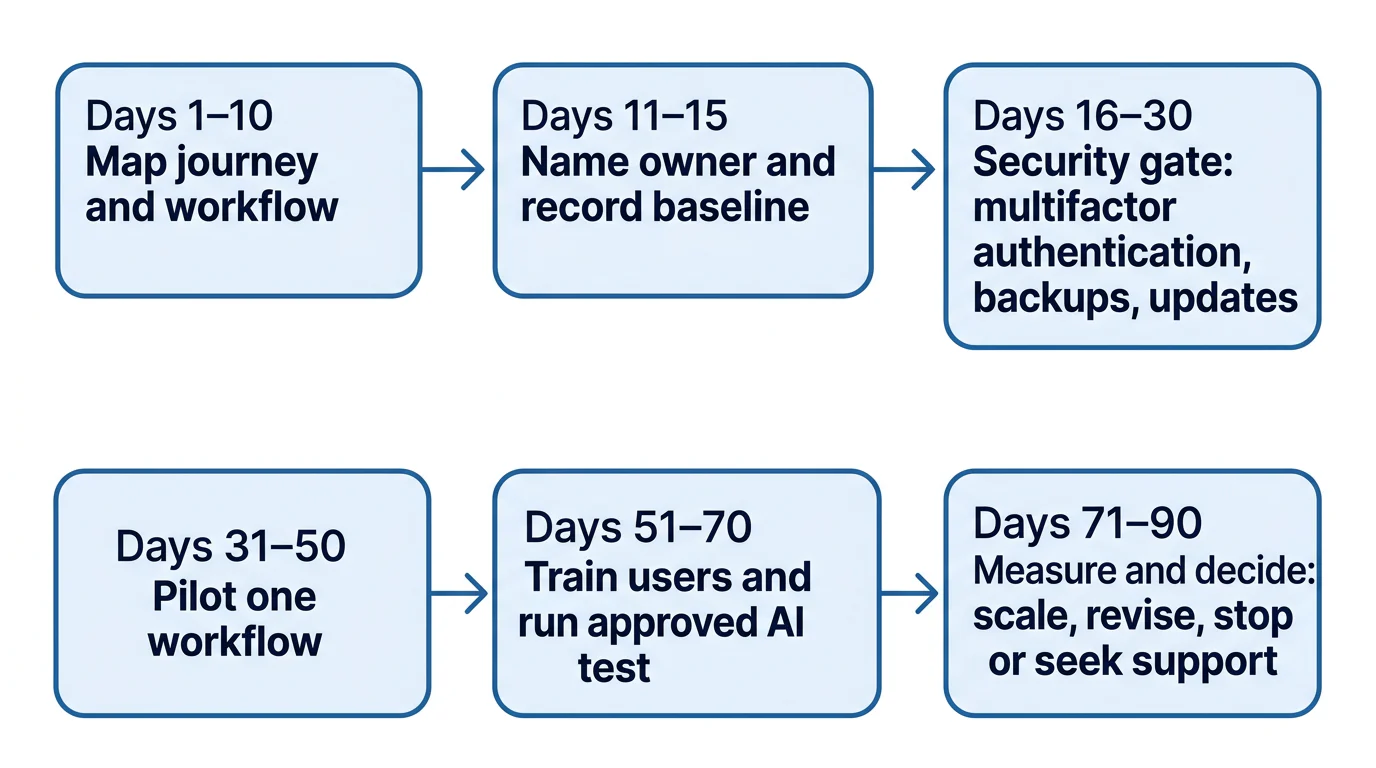
Use this roadmap as an ownership board, not a software shopping list. The sequence keeps customer experience, operations, security, team adoption and AI experimentation connected to one accountable decision.
Ninety-day owner and security flow