Brand Sprint vs Private Coaching for Consultants
Compare a personal branding sprint and private coaching for consultants, including 12-week outputs, support, ROI, and maintenance.

By Rohini Mundra, Founder · Updated 11 Oct 2026

In brief
At Rohini Mundra, we help consultants choose between a defined 12-week brand sprint and ongoing private coaching by looking at deadline, message clarity, proof, feedback needs, and implementation capacity. This guide shows the assets each route should produce, a practical twelve-week sequence, ROI measures, and a maintenance plan for turning visibility into qualified conversations.
In this article
- 1Which Personal Branding Sprint vs Private Coaching for Consultants Format Fits You?
- 2What Does Each Format Produce?
- 3What Happens During a 12-Week Brand Sprint?
- 4Weeks One to Three: Discovery and Positioning
- 5Weeks Four to Six: Message Architecture and Assets
- 6Weeks Seven to Nine: Publishing and Commercial Use
- 7Weeks Ten to Twelve: Feedback and Handoff
- 8How Does Support Differ After the First Call?
- 9How Do We Measure Personal Branding Coaching ROI?
- 10What Happens After a Brand Sprint Ends?
- 11Work with Rohini Mundra
- 12FAQs on Personal Branding Sprint vs Private Coaching for Consultants
Consulting buyers do their homework early: in LinkedIn’s 2024 survey, 58% said they picked a winning consultancy before final evaluation.
A personal branding sprint vs private coaching for consultants is a choice between a defined asset-building deadline and continuing strategic feedback. Choose a 12-week sprint when you can implement decisions now and need a clear handoff; choose private coaching when your niche, offer, proof, or visibility habits need repeated testing.
We will help you assess the fit, define the outputs worth paying for, map a practical 12-week sequence, compare support, measure commercial return, and keep the work useful after the initial engagement ends.
Which Personal Branding Sprint vs Private Coaching for Consultants Format Fits You?
The right format depends less on whether you are new to visibility and more on what is still moving. A consultant with a firm offer, clear buyer, useful proof, and a deadline can make fast progress through a defined sprint. A consultant still testing a niche, changing services, or building the confidence to publish regularly usually benefits from more time and recurring feedback.
Starting from zero visibility is not a reason to postpone the work. It is a reason to make the foundation specific. We begin by clarifying what clients should remember, what they should believe, and what they should do next. Our Brand New Brand You resources can support the broader authority-building work around that foundation.
| Comparison Factor | Defined Brand Sprint | Ongoing Private Coaching |
|---|---|---|
| Objective | Create a usable brand foundation by an agreed deadline | Improve positioning and practice as the market response develops |
| Duration | Defined, often 12 weeks | Continues for as long as the agreed support is useful |
| Deliverables | Agreed brand assets and a handoff system | Agreed feedback, decisions, and selective asset work |
| Live Access | Scheduled sessions within the sprint | Recurring sessions over a longer period |
| Feedback | Defined channels and turnaround expectations | Repeated feedback as new questions arise |
| Revisions | Set approval points and revision rounds | Reviewed within the agreed coaching rhythm |
| Accountability | Weekly milestones and implementation ownership | Ongoing check-ins and course correction |
| Maintenance | A handoff plan after the final week | Continues while the brand or business changes |
| Verified Price | Our public 12-week speaker, trainer, and coach program is listed at ₹4,00,000 | Private-coaching terms are discussed before engagement |
A useful rule is simple: choose a sprint when the decisions are ready to be made, and choose private coaching when the decisions still need market testing. Research on career outcomes also supports treating personal branding as more than profile polish, since perceived employability mediated the link between personal branding and career satisfaction in a 2019 study.
Use this self-score before deciding:
- Offer Clarity: Can you describe a specific service, buyer, and outcome without changing the answer each week?
- Proof Readiness: Do you have results, experience, credentials, or client language to support your promise?
- Deadline Pressure: Do you need usable positioning and assets before a launch, promotion, or business-development push?
- Implementation Time: Can you protect time each week to review, approve, publish, and use the assets?
- Feedback Need: Will you need guidance on new offers, live sales conversations, or market shifts after the first assets are complete?
- Visibility Habit: Can you maintain a realistic publishing and proof-collection rhythm without constant external accountability?
- Maintenance Capacity: Can you review your message quarterly and update it when the business changes?
High scores on clarity, proof, deadline, and implementation point toward a sprint. High scores on feedback need and change point toward ongoing coaching.
What Does Each Format Produce?
A short engagement should not sell vague confidence or generic “visibility.” It should leave you with a set of commercial tools that make it easier for the right people to understand your expertise, remember your point of view, and start a relevant conversation.
We expect the work to create a positioning statement, niche definition, category language, proof architecture, brand story, LinkedIn profile, website messaging, and content system. The exact scope matters. Before any work begins, we define which assets are included, who approves them, and what “finished” means. If a website requires build or implementation support beyond message strategy, our business services page is the appropriate next reference.
| Asset Or Outcome | Sprint Expectation | Ongoing Coaching Contribution |
|---|---|---|
| Positioning Statement | Create and approve a clear market promise | Test and refine it as feedback arrives |
| Niche Definition | Identify the most credible audience and problem | Reassess when demand or expertise shifts |
| Category Language | Establish memorable words for the work | Strengthen language through repeated use |
| Proof Architecture | Organize results, experience, and credibility signals | Add new proof as work develops |
| Brand Story | Build a concise narrative that supports trust | Adapt the story for new audiences or offers |
| LinkedIn Profile | Align profile with positioning, proof, and next step | Review performance and update over time |
| Website Messaging | Create a message hierarchy for key pages | Refine after sales and buyer feedback |
| Content System | Set themes, formats, and a practical cadence | Improve ideas, consistency, and commercial relevance |
The positioning work should answer five questions in one coherent line: who you help, the problem you solve, the expertise you bring, the method that differentiates you, and the engagement a buyer can purchase. That specificity matters because 41% of consultancy buyers in the buyer survey said specialisation influences their choice.
Try this category-of-one worksheet before choosing a format:
- Audience Problem: What costly or frustrating problem does your best client need solved?
- Credible Expertise: Which experience, pattern recognition, or results make your view worth hearing?
- Differentiated Method: What do you do differently from a generalist approach?
- Proof: What client outcome, case example, credential, or repeatable process supports the claim?
- Commercial Offer: What can a client buy from you now?
Turn those answers into a sentence such as: “I help [specific audience] solve [specific problem] through [differentiated method], supported by [credible proof], through [commercial offer].”
What Happens During a 12-Week Brand Sprint?
A 12-week sprint works when it moves from diagnosis to decisions, then from assets to use. We do not treat the first month as a prolonged brainstorm. The goal is to make the core positioning decisions early enough to build useful messages, publish with intent, and leave with a maintenance system.
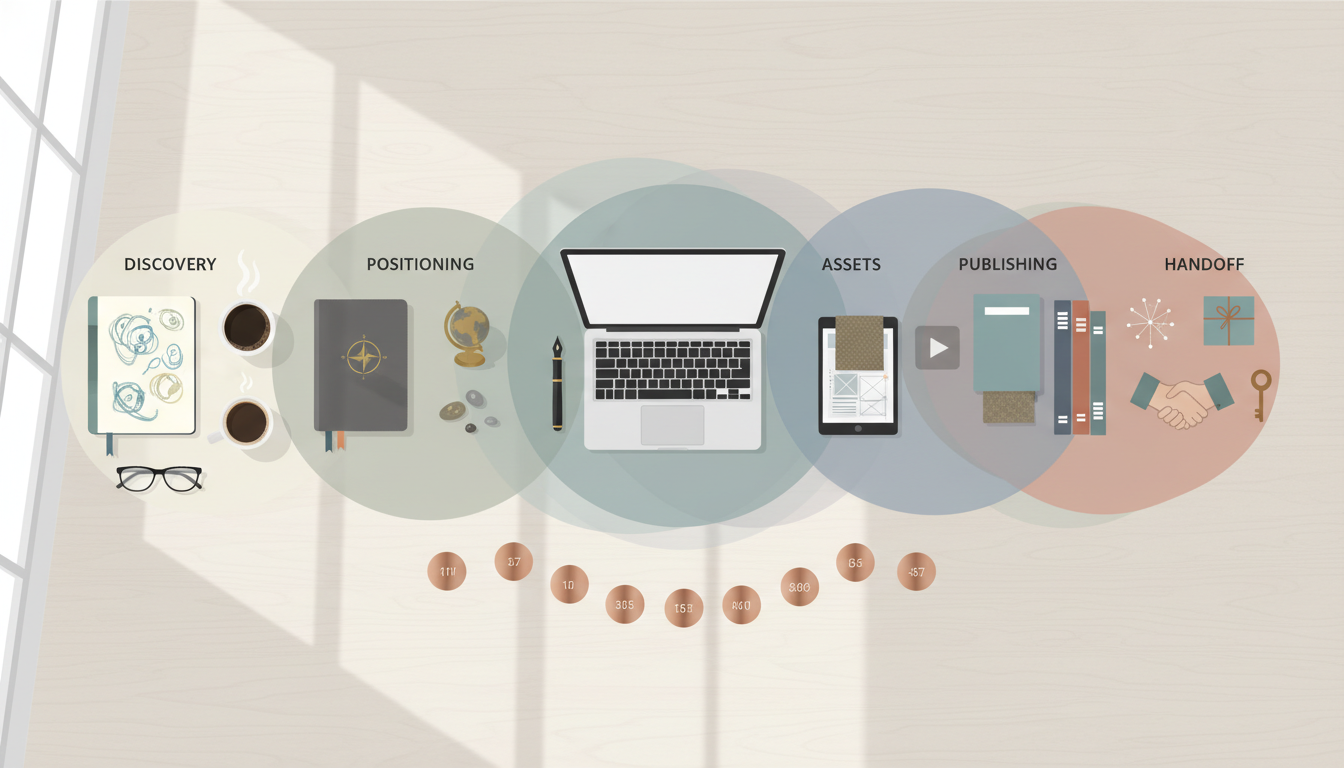
Weeks One to Three: Discovery and Positioning
Week one establishes the baseline: current profile, website, offer, client proof, referral language, inbound conversations, and existing visibility. Week two narrows the buyer, problem, niche, commercial offer, and credible point of difference. Week three converts those decisions into category language, a positioning statement, and a proof architecture.
Weeks Four to Six: Message Architecture and Assets
Week four develops the brand story and message hierarchy. Week five applies that hierarchy to LinkedIn, including the headline, About section, Experience section, Featured content, proof, and call to action. Week six turns the same core message into a website brief, so a buyer receives a consistent answer wherever they first encounter you.
Weeks Seven to Nine: Publishing and Commercial Use
Week seven creates content pillars tied to buyer problems, proof, and a real point of view. Week eight builds a manageable backlog of ideas and identifies the evidence you need to collect as client work progresses. Week nine aligns proposals, discovery calls, and referral language with the positioning, so your message does not disappear when a conversation becomes commercial.
Weeks Ten to Twelve: Feedback and Handoff
Week ten puts the message into use and records what qualified people ask. Week eleven revises where buyer feedback exposes confusion or weak proof. Week twelve packages the message, content system, baseline metrics, and a 30-, 60-, and 90-day review plan. Our Business Growth Guide can help consultants turn those commercial insights into wider operating priorities.
High-quality thought leadership is part of this system, not a separate social-media task. In a study of 3,484 executives, 73% trusted thought leadership more than marketing materials for assessing capability. That is why we anchor publishing in proof, useful guidance, and a distinctive perspective.
How Does Support Differ After the First Call?
The support model is where a neat program outline can become either useful or disappointing. A sprint should state how many live sessions are included, what can be reviewed between calls, the expected response window, how many revision rounds are available, and where the work formally ends. Private coaching should make those same boundaries visible, while leaving room for the ongoing decisions that a changing consulting business creates.
LinkedIn belongs in the brand system because buyers use it as a research surface, not because every consultant needs to chase algorithm trends. We use the profile to make specialisation, proof, offer, and next step easy to understand. We use publishing to demonstrate expertise and begin qualified conversations. Our video resources can also help you develop a visible point of view in formats beyond written posts.
A defined sprint is strongest when the consultant owns implementation between meetings. A private-coaching relationship is strongest when the consultant needs repeated challenge, feedback on fresh proof, and help translating changing experience into clearer market language. Neither model should obscure responsibilities.
- Live Access: Agree session frequency, length, attendance, and rescheduling terms before work starts.
- Asynchronous Feedback: Specify the channel, turnaround expectation, and the kinds of material that can be submitted.
- Revision Limits: Define included rounds, approval deadlines, and how new ideas will be handled after sign-off.
- Accountability: Decide how weekly commitments will be documented and what happens if implementation slips.
- Post-Program Support: Identify the handoff date, maintenance review, and trigger for returning to coaching.
For consultants who need live learning and structured interaction alongside their own implementation, our workshops offer another way to keep momentum without confusing a workshop with private strategic support.
How Do We Measure Personal Branding Coaching ROI?
We measure return through commercial movement, not follower counts alone. A better brand should make it easier for the right people to understand your value, refer you accurately, respond to your proposal, and contact you with a relevant problem. Those signals can be recorded before the work begins and reviewed after the assets are in use.
Start with a 90-day baseline. Record qualified conversations, relevant profile views, inbound enquiries, referral sources, proposals sent, proposal-to-win rate, and revenue influenced. Define “qualified” before counting. For many consultants, it means a person or company that fits the intended audience, has a real problem, and has a plausible route to purchase.
Use these simple measures:
- Profile-To-Enquiry Conversion: Qualified inbound enquiries divided by relevant profile visits.
- Qualified-Conversation Rate: Qualified conversations divided by all inbound conversations.
- Proposal Quality: The share of proposals sent to well-matched buyers with an explicit problem and decision process.
- Proposal-To-Win Rate: Won proposals divided by submitted proposals.
- Referral Clarity: The share of referral sources that describe your specialisation accurately.
- Revenue Influenced: Closed work where the buyer identifies your content, profile, website, or referral message as an influence.
- Return On Investment: Revenue influenced minus coaching and implementation cost, divided by total investment.
Do not force a revenue conclusion before your normal sales cycle has run. Coaching research can provide context but not a personal guarantee. An older ICF client study found that 68% of individual respondents who reported financial benefit had at least recovered their investment. Your own baseline and follow-up data remain the decision standard.
What Happens After a Brand Sprint Ends?
The handoff is successful when you know what to do without turning visibility into another full-time job. We recommend a small operating rhythm: publish one useful insight or proof-led observation each week, collect client proof each month, and review positioning, profile, website language, offers, and metrics each quarter.
A brand should evolve when the business evolves. A new offer, a stronger case study, repeated unqualified enquiries, a major shift in audience, or two months without a practical publishing rhythm are all valid reasons to return for strategic feedback. The goal is not endless dependence. It is a brand system you can run, inspect, and improve.
Your story is part of the proof, especially when it connects to the work clients now trust you to do. Explore Rohini’s story for a broader view of our approach to purpose, expertise, and growth.
Work with Rohini Mundra
At Rohini Mundra, we help consultants make a clear brand-building decision before they commit time, attention, and money. Our first conversation looks beyond profile polish: we examine the buyer you want, the problem you can credibly own, the proof already available, your offer, your deadline, and the time you can protect each week. From there, we can decide whether a defined sprint with tangible assets or continued private coaching will better serve your next commercial goal. We also make the support boundary explicit, including feedback cadence, implementation ownership, and what happens after the initial work is complete. If you are starting with little visibility, that does not disqualify you. It simply makes positioning, proof, and a practical publishing rhythm more important. Bring your current profile, website, offer, and goals, then we will assess the right starting point together at Rohini Mundra.
FAQs on Personal Branding Sprint vs Private Coaching for Consultants
Can a Consultant Build a Personal Brand in Three Months?
Yes. Three months can create a usable foundation: a niche, message, proof structure, profile, and publishing rhythm. Recognition grows through consistent implementation after the sprint.
What Should Short-Term Personal Branding Coaching Deliver?
A short-term program should deliver agreed positioning, proof architecture, profile and website messaging, a content system, feedback boundaries, and a clear maintenance handoff plan afterward.
Is Private Coaching Better When I Have Zero Visibility?
Not automatically. Zero visibility suits a sprint when your offer and buyer are clear. Choose private coaching when you need ongoing help testing both in market.
Does LinkedIn Matter If Referrals Drive My Work?
Yes. Referred buyers often research you before replying. A clear LinkedIn profile reinforces referral clarity, proof, and your commercial offer without replacing trusted relationships entirely.
When Should I Continue with Private Coaching After a Sprint?
Continue when your niche or offer changes, qualified conversations remain weak, implementation repeatedly stalls, or fresh proof requires a substantial message and strategy review process.