
Glossary
Money Mindset
Money mindset is the set of beliefs, feelings and habits you hold about money. Researchers group them into four recurring patterns called money scripts, each testable against your own numbers.

By Rohini Mundra, Founder · Updated 23 Oct 2026
On this page
- 01Definition
- 02Quick facts
- 03What does money mindset mean, and what is it not?
- 04What are the four money scripts?
- 05Is attitude or knowledge the bigger money gap in India?
- 06How much do savings-account, FD and equity beliefs cost you on ₹10 lakh in a year?
- 07How do you test one money belief in seven days?
- 08How Rohini Mundra handles it
- 09Example
- 10Related terms
- 11Frequently asked
What is money mindset?
Money mindset is the set of beliefs, feelings and habits you bring to earning, spending, saving, giving and risk. It is the sentence running in your head when you quote a fee or open a bank statement.
Key takeaways
- Money mindset becomes testable when you write a belief as one sentence plus one number.
- Researchers describe four money scripts: avoidance, worship, status and vigilance. They are linked to income and net worth, but the evidence cannot show they cause either.
- In India's 2019 national survey, 89% had a positive financial attitude, but only 53% passed on behaviour and 49% on knowledge.
- At September 2026 rates and inflation, one year cannot settle "only FDs" (keep all savings in FDs) or "just invest" (put savings in shares), but idle cash costs money and shares can fall in a single year.
Quick facts
- Four patterns
- Avoidance, worship, status and vigilance
- Study behind the scripts
- 2011, Journal of Financial Therapy, 422 people rating 72 money statements
- India attitude gap (2019)
- 89% positive attitude, 53% passed on behaviour, 49% on knowledge
- Often confused with
- Financial literacy and scarcity mindset
Most advice on money mindset asks you to feel differently and wait for your bank balance to follow. A more useful habit is to write the belief as one sentence and check it against one number.
The belief is rarely the only problem. One reader who tripled their salary still writes that they don't feel "safe". Another, about to start a job paying around ₹1.1 lakh a month, asks whether budgeting hard makes them "Kanjoos", the Hindi word for miserly. Neither lacks positivity. Both hold a belief about enough, guilt or risk, and a belief can be checked.
This page defines the term, names the four money scripts, and gives you a seven-day table to test one. It is written for coaches, speakers, entrepreneurs and professionals in India, whose income can swing and whose fee is a belief before it is a number. It is general education, not investment or tax advice.
What does money mindset mean, and what is it not?
It is not a skill, and thinking differently does not by itself change your income.
It is often confused with financial literacy, which is knowledge, and with a scarcity mindset, which is one pattern: the belief that there is never enough. A limiting belief is any belief that holds you back.
What are the four money scripts?
The four money scripts are avoidance (money is bad, or I do not deserve it), worship (more money will solve my problems), status (my worth equals my net worth) and vigilance (be watchful and secretive with money). You may recognise more than one.
The four money scripts and their core beliefs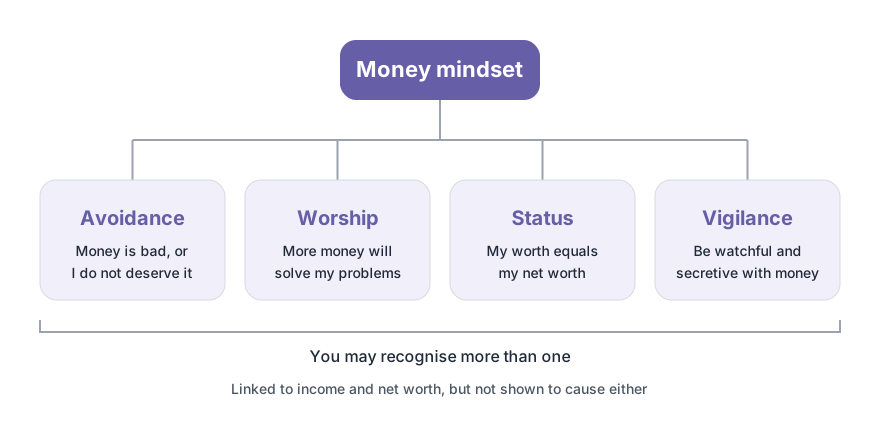
A 2011 study in the Journal of Financial Therapy found these four among 422 people who rated 72 money statements. Three correlated with income and net worth; avoiders had lower or unknown income and net worth.
The limits matter: a web convenience sample, 82% Caucasian and relatively wealthy and educated, with cut-off scores still to be set. Use the scripts to name a belief, not to diagnose yourself.
Is attitude or knowledge the bigger money gap in India?
Knowledge and behaviour are the bigger gap. In the National Centre for Financial Education's 2019 survey (75,140 people surveyed between June 2018 and October 2019), 89% had a positive financial attitude, but 53% passed on behaviour and 49% on knowledge, and 27% counted as financially literate. Pass marks differ by component, so read the gap as a direction.
Caution is also common. In the Securities and Exchange Board of India (SEBI) Investor Survey 2025 of over 90,000 households, 9.5% invest in securities and nearly 80% prefer protecting capital to higher returns. Preferring to protect capital is common, and one year of Nifty falls does not settle whether it is wise.
How much do savings-account, FD and equity beliefs cost you on ₹10 lakh in a year?
At September 2026 rates and inflation, ₹10 lakh in a State Bank of India (SBI) savings account loses 2.88% of its buying power and a one-year FD gains 0.67% before tax. Over the 12 months to 30 September 2026, the Nifty 50, an index of 50 large companies listed on the stock exchange, lost 11.97% in real terms. One year cannot settle either slogan, but idle cash costs money and shares can fall in a single year.
Real return is what your money earns after subtracting inflation. The model was run in October 2026: real return = (1 + rate) ÷ (1 + inflation) − 1, with inflation at 5.54%, the consumer price index rise for September 2026 over September 2025 (provisional). It treats one month's inflation as next year's and ignores tax; subtract tax at your own slab.
Rates: SBI's published rate page (deposit rates effective 15 December 2025, savings rate 15 June 2025). The Nifty figure, price plus dividends to 30 September 2026, is from the National Stock Exchange (NSE) factsheet. One year is a snapshot, not a forecast.
Idle money in a savings account is the costliest belief in the table; which other row suits you depends on when you need the money.
- Where ₹10 lakh sat for one year
- SBI savings account
- Rate
- 2.50%
- After a year (₹)
- 10,25,000
- In today's prices (₹)
- 9,71,196
- Real return
- -2.88%
- Where ₹10 lakh sat for one year
- SBI 1-year FD
- Rate
- 6.25%
- After a year (₹)
- 10,62,500
- In today's prices (₹)
- 10,06,727
- Real return
- +0.67%
- Where ₹10 lakh sat for one year
- Nifty 50 Total Return Index, last 12 months
- Rate
- -7.09%
- After a year (₹)
- 9,29,100
- In today's prices (₹)
- 8,80,330
- Real return
- -11.97%
How do you test one money belief in seven days?
Pick the script closest to your own sentence, run its test, and score pass or fail on day seven. Test one belief a week. These tests are a recommendation, not research findings.
If you sell your expertise, run the avoidance test on your fee. Write the fee you quote, then the fee you would quote a client you admire. Quote the higher one to one prospect this week, with no discount offered first. Pass: you state it and wait. Fail: you lower it before they react.
- Script
- Avoidance
- The sentence
- "I'll look at money later."
- Seven-day test
- Day 1 and day 7: write your balance and last month's income from memory, then check both against your bank app
- Pass / fail
- Pass: on day 7 both are within ₹1,000 of the app figures. Fail: either is further off
- Script
- Worship
- The sentence
- "More income will fix it."
- Seven-day test
- Day 1: work out saved ÷ income for the month before and after your last raise. Day 7: work it out for this month
- Pass / fail
- Pass: this month's rate is no lower than the before-raise rate. Fail: it is lower
- Script
- Status
- The sentence
- "I need to look successful."
- Seven-day test
- Day 1: tag last month's visible spending (clothes, car, events). Day 7: tag this week's as you spend
- Pass / fail
- Pass (a rule of thumb, chosen so showing never outweighs keeping): visible spend is no larger than savings. Fail: larger
- Script
- Vigilance
- The sentence
- "Only safe money is real."
- Seven-day test
- Day 1: pick an amount and the row of the table above that best matches where it sits. Day 7: write what it earns after inflation
- Pass / fail
- Pass: you can say what it earns after inflation. Fail: you cannot
How Rohini Mundra handles it
Rohini Mundra works on the mindset and business side of Purpose, Passion and Profit. The three-month Private Coaching begins with Inner Awareness ("understand your nature and quiet overthinking"), moves through Soul and Karma, and ends with Living the Wisdom, applying peace "in real life, under real pressure". The Brand New Brand You masterclass helps individuals and businesses build a unique, authentic and memorable brand identity. See the programmes and programme prices.
Choosing a coach? Read mindset coach vs life coach, and for how a belief is reprogrammed, reprogram your subconscious mind. To ask about fees or fit, contact us.
Example
Take the vigilance sentence "Only safe money is real" and ₹10 lakh held for a year. In the table above, the one-year FD ends at ₹10,06,727 in today's prices against ₹9,71,196 for the savings account, a gap of ₹35,531. Writing that gap down is the "one number" that tests the belief.
Frequently asked
Sources
- 1.Klontz, Britt, Mentzer and Klontz (2011), Money Beliefs and Financial Behaviors, Journal of Financial Therapy 2(1)
- 2.NCFE Financial Literacy and Inclusion Survey 2019, executive summary
- 3.SEBI Investor Survey 2025
- 4.MoSPI, Consumer Price Index press release, September 2026
- 5.NSE Indices, Nifty 50 factsheet, 30 September 2026
- 6.Reddit r/personalfinanceindia: financial insecurity after a raise
- 7.Reddit r/personalfinanceindia: "Am I being Kanjoos?"