Why Is My Coaching Revenue Stuck? A Coaching Business Revenue Plateau Diagnosis
Diagnose a coaching business revenue plateau, find the constraint, and take a focused 30-day action plan without adding more hours.

By Rohini Mundra, Founder · Updated 11 Oct 2026

In brief
A coaching business revenue plateau usually happens because demand, conversion, pricing, delivery capacity, retention, or founder dependence cannot support the next stage of growth, and working longer hours rarely removes that constraint. We help you tell a real ceiling from a temporary slowdown, audit the numbers to locate where revenue stops moving, and choose a focused 30-day plan to fix that system first.
In this article
- 1Is This a Real Plateau or a Temporary Sales Slowdown?
- 2How Do You Diagnose a Coaching Business Revenue Plateau?
- 3What Data Should We Collect First?
- 4How Do We Find the Highest-Impact Constraint?
- 5What Is the Five-Step Diagnostic?
- 6Why Should We Diagnose Before Adding More Marketing?
- 7Is Capacity or Founder Dependence Limiting Your Coaching Practice?
- 8How Do We Complete a Time and Capacity Audit?
- 9Which Activities Create Leverage?
- 10Why Does Retention Matter to Capacity?
- 11Should We Productize, Delegate, Raise Prices, Repair Conversion, or Build Demand First?
- 12What Should We Do in the Next 30 Days?
- 13How Can Rohini Mundra Help You Break the Ceiling?
- 14FAQs on Coaching Business Revenue Plateau
A flat month is not always a structural problem. In a recent government survey, 36% of SME employers reported sales growth, which is a useful reminder that business performance moves before it settles into a pattern.
A coaching business revenue plateau usually happens because demand, conversion, pricing, delivery capacity, retention, or founder dependence cannot support the next stage of growth. Working longer hours rarely removes that constraint. We need to locate where revenue stops moving, then improve that system before adding more clients, campaigns, or complexity.
We will help you distinguish a real ceiling from a temporary slowdown, audit the numbers behind it, and choose a practical 30-day response. For broader planning support, use our Business Growth Guide.
Is This a Real Plateau or a Temporary Sales Slowdown?
A plateau is a repeating ceiling, not one quiet week, a delayed payment, or a seasonal gap in enquiries. If revenue, client count, or your available time keeps returning to the same range despite consistent effort, we are likely looking at a system constraint.
Start with comparable periods. Review recent months alongside the same period last year if your coaching business has launch cycles, holidays, or event-driven demand. Then look beyond revenue alone. A full calendar, flat income, weak renewals, or inconsistent sales calls can each point to a different problem.
A temporary slowdown usually has a clear explanation and a recovery path already in motion. A structural ceiling keeps appearing because the business lacks a repeatable way to create demand, convert it, deliver at a healthy margin, retain clients, or operate without the founder handling everything.
Avoid responding to every soft month with a new offer or a new campaign. First identify the recurring pattern. That restraint protects your time and makes the next decision easier to measure.
How Do You Diagnose a Coaching Business Revenue Plateau?
The fastest way to lose momentum is to treat every issue as a marketing issue. We begin with a compact diagnostic that connects visible symptoms to the metric that can confirm or reject the assumption.
| Observable Symptom | Metric To Inspect | Likely Constraint | First Intervention |
|---|---|---|---|
| Few qualified conversations | Weekly qualified lead volume and source mix | Demand | Build one repeatable lead channel |
| Plenty of calls but few sales | Show rate, close rate, and objections | Conversion | Improve qualification and offer clarity |
| Full calendar but flat revenue | Average fee and revenue per delivery hour | Pricing | Test a clearer, higher-value package |
| Delivery backlog and long weeks | Delivery hours per client and turnaround time | Capacity | Productize, cohort, automate, or add support |
| Constantly replacing clients | Renewal rate, completion rate, and referrals | Retention | Improve outcomes and renewal pathways |
| Every decision needs you | Founder-only tasks and approval delays | Founder Dependence | Document and delegate recurring work |
What Data Should We Collect First?
Pull the last 90 days of leads, sales calls, proposals, clients, average fees, renewals, and hours worked. We do not need perfect reporting. We need a clear enough view to see whether the blockage occurs before the sale, at the sale, during delivery, or after the engagement.
Calculate the simple operating equation: revenue equals active clients multiplied by average fee. Then ask what is flat. If client volume is flat, inspect demand and conversion. If client volume is healthy but income is flat, inspect pricing, scope, capacity, and retention.
How Do We Find the Highest-Impact Constraint?
Choose the constraint that would create the greatest revenue improvement if it improved first. A coach with too few qualified leads does not need another operations tool. A coach with a full diary and low revenue per client does not need more enquiries.
This is why we encourage established coaches to build a useful baseline before changing direction. Our Extraordinary Coach Guide can help you reconnect offer design with the outcomes clients value most.
What Is the Five-Step Diagnostic?
- Gather recent revenue, lead, call, client, renewal, and time data.
- Identify whether client volume, average fee, or retention is limiting revenue.
- Label each lead source, including referrals, repeat clients, partners, content, events, and outbound activity.
- Audit how your weekly hours are actually spent.
- Select one constraint to improve for the next 30 days.
Why Should We Diagnose Before Adding More Marketing?
More leads cannot solve a weak sales conversation, an unclear offer, or a delivery model already at capacity. In fact, more marketing can worsen fulfillment problems when a coach is already overextended.
A cleaner diagnosis prevents us from spending money or energy on the wrong lever. It also gives us a single leading metric to watch, rather than a long list of activities that feel busy but do not change the ceiling.
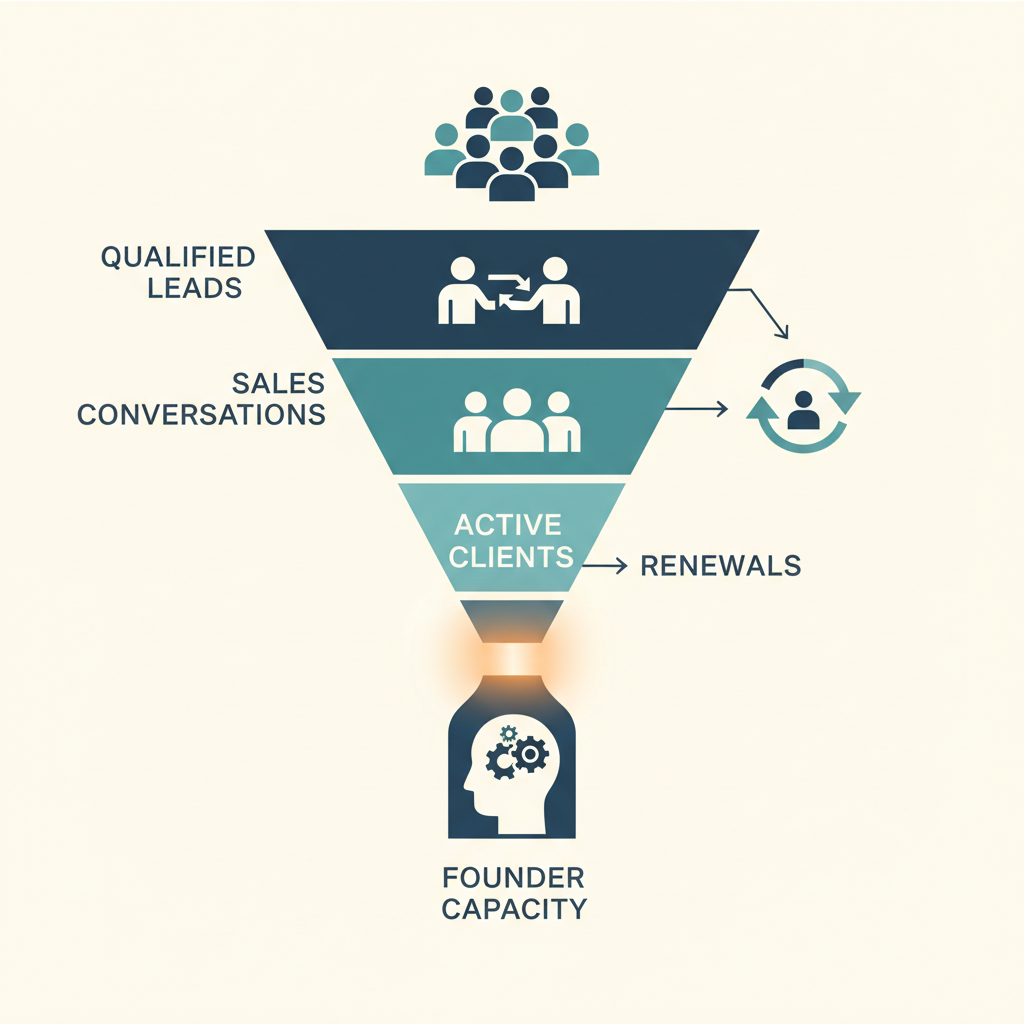
Is Capacity or Founder Dependence Limiting Your Coaching Practice?
Many coaches reach a point where more sales would create more pressure, not more freedom. One UK growth study classified 38% of surveyed small businesses as capacity constrained, though that figure is not a benchmark for coaching practices.
We need to separate delivery work from the work that makes future growth possible. The audit below exposes whether the business has a marketing issue or simply has no space left to support new demand.
How Do We Complete a Time and Capacity Audit?
List your [weekly hours], then divide them into delivery, administration, sales, marketing, and strategic work. Be honest about the time spent rescheduling sessions, preparing custom materials, answering client messages, and approving small decisions.
Next, calculate available delivery capacity. Divide the delivery hours you can sustainably protect by [delivery hours per client]. Multiply the resulting active-client capacity by [average fee] to see the revenue ceiling created by your current model.
Then work backward from the growth target. Divide the number of additional clients needed by [close rate] to estimate the sales conversations required. Compare that with [lead volume], then factor in [retention rate] to see how often you must replace clients.
Which Activities Create Leverage?
Productizing does not mean turning personal coaching into generic content. It means standardizing the repeatable parts of an effective client journey, such as onboarding, diagnostic questions, templates, resources, progress reviews, and follow-up.
Group cohorts can add leverage when clients benefit from a shared stage, common problem, or peer accountability. Delegation can remove scheduling, research, client operations, design, and routine follow-up from the founder’s calendar. Our Digital Transformation Program explores how systems can support this shift.
Why Does Retention Matter to Capacity?
Retention reduces the number of new clients required simply to stay at the same revenue level. It also makes delivery planning easier because renewals are more predictable than a pipeline built only on referrals.
A 2025 study of 126,335 online customers found that returning customers created greater value than new visitors. The research concerns retail, not coaching, but the operating lesson remains relevant: measure renewals and client value instead of treating every month as a fresh acquisition challenge.

Should We Productize, Delegate, Raise Prices, Repair Conversion, or Build Demand First?
The right action depends on the constraint, not on whichever tactic is currently popular. We do not need to rebuild the whole business. We need to make the most limiting part less limiting.
| If The Audit Shows This | Prioritize This | Do Not Prioritize First |
|---|---|---|
| Qualified lead volume is too low | Build a repeatable lead source | More operational complexity |
| Calls happen but sales stay weak | Repair qualification and conversion | More traffic or ad spend |
| Delivery is full but revenue remains low | Repackage or test pricing | Adding more one-to-one clients |
| Founder delivery is at capacity | Productize, cohort, delegate, automate | A larger launch |
| Clients leave without renewing | Improve retention and client experience | Aggressive top-of-funnel growth |
| Every workflow needs founder approval | Define decision rights and delegation | Hiring without clear ownership |
If demand is the constraint, choose one reliable way to create qualified conversations and track it weekly. Referrals can remain valuable, but they should not be the only acquisition system. A consistent channel gives us visibility before the monthly revenue number reveals the problem.
If pricing is the constraint, do not change a number in isolation. Improve the package definition, client outcome, scope boundaries, and proof before testing it with the right prospects. Strong positioning also matters here, and Brand New Brand You can help you clarify what makes your expertise easier to choose.
If capacity is the constraint, protect quality while redesigning delivery. Standardize what is repeatable, keep personal attention where it matters, and stop accepting custom work that adds effort without strengthening the client outcome.
Founder dependence needs a different intervention. Create a task inventory and identify what only you can do, what another person can do with a checklist, and what can be automated. Define decisions that others can own, document the steps that repeat, and create a review rhythm that keeps you informed without becoming the bottleneck. Effective delegation should release strategic time, not create another layer of approvals.
For a structured approach to growing delivery capacity while protecting client outcomes, explore our Business Coaching Programs.
What Should We Do in the Next 30 Days?
Once we identify the bottleneck, the next month should feel narrower, not busier. We choose one measurable intervention and give it enough time to produce evidence.
In the first week, complete the diagnostic, the lead-source map, and the capacity audit. Set one leading metric that sits close to the constraint. That may be qualified leads each week, sales-call show rate, close rate, revenue per delivery hour, renewal rate, or founder hours released.
In the second and third weeks, run one focused test. Build a single lead routine, simplify the sales process, pilot a revised package, delegate a repeatable workflow, or introduce a structured renewal conversation. Keep the test small enough to learn from it.
During the final week, review the result. If the leading metric moved, continue and refine. If it did not, revisit the diagnosis before adding another project. Live practice and peer learning can support this discipline through our Workshops and Seminars.

How Can Rohini Mundra Help You Break the Ceiling?
At Rohini Mundra, we help established coaches who have outgrown improvisation but do not want to lose the personal standard that made clients trust them. We start by separating a demand problem from a conversion, pricing, capacity, retention, or founder-dependence problem. Then we help turn the chosen priority into a practical weekly operating rhythm: what to measure, what to stop doing, what to standardize, and what to test before adding complexity. Our work is for owners who are ready to protect delivery quality while creating a business that does not pause whenever they are in sessions. If your audit shows that the issue is bigger than one tactic, our structured coaching can help you move from scattered activity to a clearer growth system. We also help you set clear ownership and review results without chasing every trend. Explore our approach at Rohini Mundra Home.
FAQs on Coaching Business Revenue Plateau
These answers help us apply the diagnostic without turning every revenue fluctuation into a major business decision. Use them alongside your own sales, capacity, and client-retention data.
How Long Should I Watch Revenue Before Calling It a Plateau?
Treat it as structural when comparable periods repeatedly stall and the funnel, client load, and founder hours point to the same constraint, rather than one isolated soft month.
Should I Fix Marketing or Operations First?
Start with the constraint that most directly blocks revenue. More marketing comes first only when qualified lead volume is insufficient and delivery, pricing, and conversion are sound.
Can I Scale While Keeping Personal Coaching?
Yes. Keep personal coaching for clients who need it, then standardize onboarding, resources, reviews, and group elements so founder time no longer rises with every new client.
Does a Full Calendar Mean I Should Raise Prices?
A full calendar signals a capacity question, not an automatic price rise. Review average fee, delivery time, client outcomes, demand, and margin before testing a revised package.
What Metric Should I Track First When Revenue Is Stuck?
Track the weekly metric nearest your bottleneck: qualified leads for demand, close rate for conversion, delivery hours for capacity, or renewals for retention over time.